DPR
Dissociated Pain Release
A self-help technique developed by a trauma survivor

Anne MacMillan, MLA
Survivor, Consultant, Coach
Master's Clinical Psychology - Harvard University
Dissociated Pain Release
Self-Help Trauma Support
Dissociated Pain Release
Dissociated Pain Release (DPR) is a self-help technique that allows users to release emotional pain from trauma without re-experiencing it. It is based on the idea that emotional pain is stored in the mind, body, and nervous system and that the stored pain causes distress and discomfort in the present, whether the trauma was a recent event or something that happened many years ago.
There is no need for a DPR user to know where any emotional pain came from. All a user needs to know is that they are currently experiencing unwanted emotional pain and that they would like to release that pain and feel better -- quickly.
Most importantly, in DPR, emotional pains are released while the user is dissociated from them -- allowing the user to process any trauma or distress without being forced to relive the original traumatic experience.
Examples of emotional pain that can be released from the body and nervous system through DPR include rage, anger, shame, sadness, guilt, grief, loneliness, abandonment, anxiety, and fear.
Likewise, DRP allows users to release any stored sensations associated with physical pain or forms of bodily discomfort that happened in the past. DPR users can release sensations of nausea, dizziness, cold, being drugged, etc. Again, all these sensations are released without the DRP user re-experiencing the original potency of any traumatic event. Often DPR users release pain without even knowing what the original traumatic event may have been.
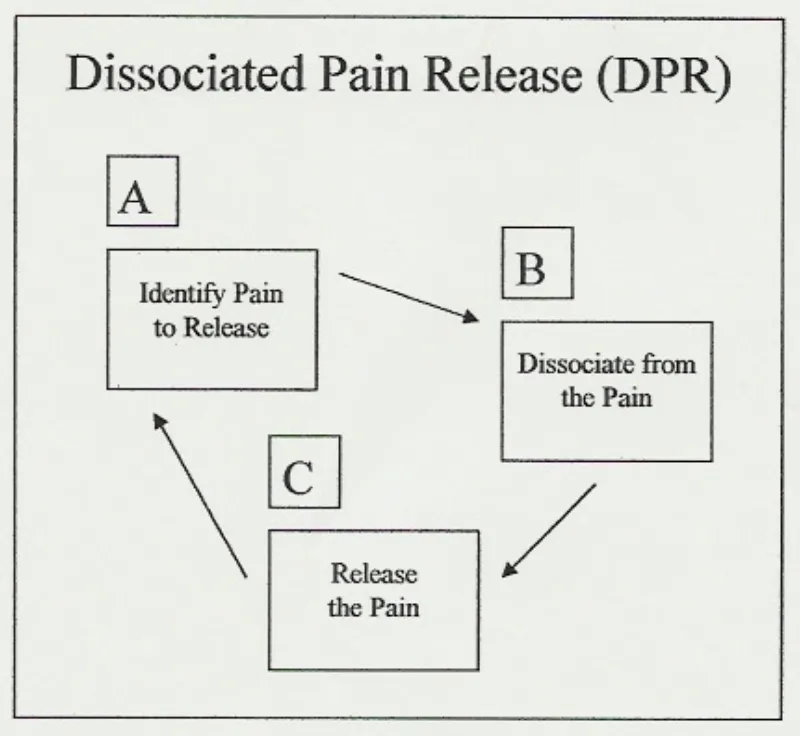
DPR has three cyclical steps: (A) identify pain to release, (B) dissociate from the pain, and (C) release the pain. Once understood, DPR is a simple, repetitive process that applies in many self-help situations. Any user employing DPR expects to complete its A-B-C cycle several times in any one self-help session. It is understood that there may be several painful emotions, different forms of physical pain and other negative bodily sensations that require release, making time and repetition necessary.
IMPORTANT
* DPR is not trauma therapy.
Anne is not a therapist and does not support individuals through trauma therapy. Anne teaches a self-help technique that individuals can apply to many situations in their everyday lives and that they have a right to use to manage any experiences they choose, traumatic or not. It is always recommended that trauma survivors hire a licensed trauma therapists whenever possible. Call 911 in any emergency.
Feeling Suicidal?
Find a Helpline

Anne MacMillan, MLA
Survivor, Consultant, Coach, Educator
Master's Clinical Psychology, Harvard Univerisity
IMPORTANT
* DPR is not trauma therapy.
Anne is not a therapist and does not support individuals through trauma therapy. Anne teaches a self-help technique that individuals can apply to many situations in their everyday lives and that they have a right to use to manage any experiences they choose, traumatic or not.
It is always recommended that trauma survivors hire a licensed trauma therapists whenever possible. Call 911 in any emergency.
Feeling Suicidal?
Find a Helpline:
https://findahelpline.com/
About Me
Like many others, I grew up in a household that didn't offer me the basic protections all children need. I experienced extreme trauma as a very young child and, unfortunately, that trauma continued into my adolescence and adulthood.
I survived adolescence emotionally by focusing on studying contemporary dance, helping me process my emotions and increase my body awareness. As a young adult in my twenties, I was exposed to relaxation and meditation techniques and the idea that healing that comes naturally when we move our eyes as we dream.
In my mid-twenties, memories of traumatic events that had happened during my early childhood began to return to my consciousness. I knew about EMDR (Eye-Movement Desensitization and Reprocessing) therapy for trauma, but wasn't in a situation that allowed me consistent access to a trauma therapist.
So, I began working through my traumatic memories on my own, combining what I'd learned about the emotions I felt in my body through dancing with relaxation and visualization techniques. I added what I decided to call REM Simulation -- or Rapid Eye Movement Simulation. REM sleep is the deep dreaming sleep in which humans naturally process emotions.
The result was a self-help technique that made it possible for me to work through the terrible emotions associated with traumatic events that had occurred in my past and regain the sense of emotional stability I needed -- all without having an opportunity to get the therapeutic support I needed.
Dissociated Pain Release
I dubbed my self-help technique DPR, or Dissociated Pain Release, and decided that I didn't want it to ever become something that anyone with an advanced degree and a lot of privilege could tell people they weren't qualified to perform at home on their own.
Therapy is wonderful and everyone who has access to a therapist should take advantage of that privilege. But recovery strategies should be available to anyone anywhere. That's what DPR is about for me.
From my perspective, DPR is nothing more than a collection of practical ideas put together in one package to help all of us get through the difficult emotions humans feel. It's valuable because it works and it uses human's natural REM (Rapid Eye Movement) sleep processing methods.

My Newest Blog Posts

Sequential Divorce™: A Structured Alternative for Neurodiverse Couples
Divorce is hard for everyone. For neurodiverse couples, and especially for couples where one or both partners are autistic, it can be uniquely overwhelming. The standard divorce process was not designed with neurodivergent people in mind. It often requires real-time negotiation, in-person meetings, rapid perspective-taking, and a level of social fluency that puts autistic people at a significant disadvantage.
What many couples don't realize is that in most jurisdictions in the United States, divorce does not have to involve any of that. All that is legally required in many places is a written agreement that both people have reviewed and signed, filed together at a courthouse with a nominal fee. If a judge finds the agreement fair and uncoerced, the divorce is granted. No litigation. No extended court process. Just an agreement.
Sequential Divorce™ is a structured process designed to help neurodiverse couples get to that agreement. It allows each person to work through the decisions of divorce privately, in writing, and one topic at a time, before anything is exchanged or discussed. The result is a set of written summaries that both people can use as the basis for a final agreement. As with any divorce agreement, it is important to have a qualified legal professional in your jurisdiction review the summaries and any proposed agreement before signing or filing. These resources are designed to help you arrive at that conversation organized, prepared, and ready to finalize without the stress or trauma of emotional real-time negotiation.
How autistic processing shapes the divorce experience
Autistic people tend to process complex information sequentially. Each stage of understanding builds on the one before it, and arriving at a decision, especially a consequential one, takes time. Research supports this: studies applying Dual Process Theory to autism have found that autistic individuals demonstrate greater deliberative processing, meaning slower, sequential, and more effortful reasoning, alongside reduced intuitive or fast processing. This more deliberative style is associated with greater logical consistency and less susceptibility to bias, but it requires time that standard negotiation processes rarely provide (Brosnan & Ashwin, 2023).
Standard divorce negotiation does not offer adequate time or structure. Mediation sessions are scheduled in blocks. Proposals arrive across a table and responses are expected quickly. The entire process assumes that both people can absorb emotionally charged and legally complex information and respond to it on the spot. For an autistic person who needs to work through information sequentially before they are ready to decide, that assumption does not hold.
Sequential Divorce™ removes the time pressure entirely. Each person works through one topic at a time, in writing, and at their own pace. The result is a written summary that can be reviewed, reconsidered, and exchanged only when each person is ready.
The role of trauma history in neurodiverse partnerships
Many neurodiverse couples arrive at divorce carrying years of accumulated stress. Neurodiverse partnerships often involve recurring cycles of miscommunication, unmet needs, and intermittent trauma spikes that can produce real and lasting trauma responses in both partners. Research has found that autistic adults experience PTSD at significantly higher rates than the general population, with some studies suggesting that autistic individuals may be more vulnerable to trauma responses given differences in sensory processing and emotional regulation (Quinton et al., 2024). These cycles are not usually the result of bad intentions. They are often the result of two people with genuinely different neurologies trying to connect across a significant communication gap without adequate support or understanding, what researcher Damian Milton has described as the double empathy problem, a mutual breakdown in understanding that occurs between people with very different ways of experiencing the world (Milton, 2012; Milton et al., 2022).
By the time a neurodiverse couple decides to divorce, the idea of sitting across a table and negotiating in real time may feel impossible. For many couples, it is. Any conversation about the marriage, the children, or the finances can trigger the same stress responses that have built up over years of difficult interactions.
Sequential Divorce™ is built around the understanding that written communication is often safer, clearer, and more productive for neurodiverse couples than spoken negotiation. Research consistently supports this: studies monitoring real-world smartphone communication found that autistic adults show a distinct and measurable preference for written over verbal communication, and that written formats support greater self-expression and reduce social anxiety (Turna et al., 2025). A large-scale study of communication preferences in the autistic community found that written communication was strongly preferred, particularly when interacting with unfamiliar people or navigating high-stakes situations, with participants describing written formats as giving them thinking time and control (Howard & Sedgewick, 2021). Each person works through their section privately. There is no real-time pressure, no escalating conversation, and no requirement to perform composure in front of the other person or a professional third party.
Why standard mediation often fails neurodiverse couples
Mediation is widely recommended as a less adversarial alternative to litigation, and for many neurotypical couples it works well. For neurodiverse couples, and particularly those involving autistic partners, it often does not. Mediation requires both people to respond to proposals in real time, read social cues, and manage emotional regulation under pressure. It asks autistic people to do exactly the things that are hardest for them, in one of the most stressful situations of their lives, in front of a professional they may have just met.
Shuttle mediation, where the parties are kept in separate rooms and the mediator moves between them, can reduce some of the stress that comes from being in direct contact with a former partner. For couples with a history of conflict or trauma cycles, that separation is not a small thing. But it does not resolve the pacing problem. Each person is still expected to receive proposals, process complex financial and parenting information, and respond within the timeframe of a single session. For an autistic person who needs to move sequentially through understanding before arriving at a decision, that remains a significant barrier, regardless of who is or is not in the room.
Even well-meaning mediators may not understand how autistic people process information. A silence that looks like resistance may actually be processing time. A flat affect may be masking significant distress. Research on social camouflaging documents that autistic people frequently conceal or compensate for their autistic presentation in social situations, a cognitively effortful process that is prone to breakdown under increased social demands and psychological stress (Hull et al., 2017; Cook et al., 2021). An agreement reached under those conditions may not reflect what the autistic person actually understood or intended once they have had time to think it through.
When mediation fails, couples are typically told that their only remaining option is to go before a judge. For neurodiverse couples who entered the process with good intentions and a genuine desire to reach a fair agreement, that is a painful and often unnecessary outcome. Litigation is expensive, adversarial, and slow, and it tends to escalate conflict rather than resolve it. Many neurodiverse couples end up there not because they could not agree, but because the process they were offered was not built for how they think and communicate.
Sequential Divorce™ gives each person the time and structure to think clearly before anything is exchanged. Written summaries replace real-time negotiation as the starting point. When a mediator, attorney, or other professional is eventually involved, they receive organized written proposals rather than two people in emotional conflict trying to negotiate on the fly, making professional involvement more efficient and less costly when it is needed.
Protecting autistic people and their families
Adversarial divorce is expensive, damaging, and in many cases unnecessary. It is also an environment where autistic people can be particularly vulnerable.
Autistic people often have difficulty reading the long-term social consequences of decisions made under pressure. They may not fully recognize when a professional is working against their interests or the interests of their children. They may agree to things in the moment that they would not agree to if they had time to process. And because the adversarial process tends to escalate conflict, it can permanently damage co-parenting relationships that both partners, and especially the children, depend on.
Sequential Divorce™ is designed to reduce conflict, not generate it. It keeps both people working privately and in writing, with organized written summaries as the basis for decision-making, agreement preparation, and professional review. It supports clearer thinking, reduces emotional reactivity, and helps both people arrive at the table better prepared.
How Sequential Divorce™ works
The Sequential Divorce™ resources are organized into three zones, each covering a different area of the divorce process.
The Blue Zone covers assets and debts: property, accounts, estimated values, proposed division, and items needing professional review.
The Green Zone covers parenting time and care: regular schedules, holidays, transportation, communication boundaries, decision-making, and child-specific needs.
The Gold Zone covers budget and support: income, monthly expenses, children's expenses, housing, insurance, child support, spousal support, and transition needs.
Each person completes their own version of each resource separately. The tool guides them through a structured set of questions and generates a written summary they can save, print, or share when ready. Nothing is exchanged until each person chooses to share it.
These resources are not legal advice and do not replace professional review. Before filing any agreement, both people should have their written summaries reviewed by a qualified legal professional in their jurisdiction. The goal of Sequential Divorce™ is to help both people arrive at that professional review better organized, more clear-headed, and less depleted by conflict, and hopefully with a divorce agreement in hand.
Sequential Divorce™ is neurodiversity-affirming
Sequential Divorce™ is built on a neurodiversity-affirming foundation. What neurodiverse couples often need is a process that works with their neurologies rather than demanding they perform divorce in ways that do not come naturally.
Providing a structured, written, sequential process is not a workaround or a concession. It is simply a better fit. And for many neurodiverse couples, it may be the difference between a divorce that destroys the family system and one that allows both people to move forward with their dignity, their resources, and their relationships with their children intact.
The Sequential Divorce™ resources are coming soon and the first resources are available now. You can begin with whichever zone feels most relevant or most manageable right now. There is no required order. Each resource stands on its own.
Works Cited
Brosnan, M., & Ashwin, C. (2022). Thinking, fast and slow on the autism spectrum. Autism, 27(4), 1073–1085. https://doi.org/10.1177/13623613221132437
Cook, J., Hull, L., Crane, L., & Mandy, W. (2021). Camouflaging in autism: A systematic review. Clinical Psychology Review, 89, 102080. https://doi.org/10.1016/j.cpr.2021.102080
Howard, P. L., & Sedgewick, F. (2021). “Anything but the phone!”: Communication mode preferences in the autism community. Autism, 25(8), 2265–2278. https://doi.org/10.1177/13623613211014995
Hull, L., Petrides, K. V., Allison, C., Smith, P., Baron-Cohen, S., Lai, M.-C., & Mandy, W. (2017). "Putting on my best normal": Social camouflaging in adults with autism spectrum conditions. Journal of Autism and Developmental Disorders, 47(8), 2519–2534. https://doi.org/10.1007/s10803-017-3166-5
Milton, D. E. M. (2012). On the ontological status of autism: The “double empathy problem.” Disability & Society, 27(6), 883–887. https://doi.org/10.1080/09687599.2012.710008
Milton, D., Gurbuz, E., & López, B. (2022). The “double empathy problem”: Ten years on. Autism, 26(8), 1901–1903. https://doi.org/10.1177/13623613221129123
Quinton, A. M. G., Ali, D., Danese, A., Happé, F., & Rumball, F. (2024). The assessment and treatment of post-traumatic stress disorder in autistic people: A systematic review. Review Journal of Autism and Developmental Disorders. Advance online publication. https://doi.org/10.1007/s40489-024-00430-9
Turna, M., Eckert, J., Meier-Böke, K., Narava, M., Chaliani, I., Eickhoff, S. B., Schilbach, L., & Dukart, J. (2025). Real world evidence for altered communication patterns in individuals with autism spectrum disorder. npj Digital Medicine, 8, Article 157. https://doi.org/10.1038/s41746-025-01545-x

© 2023 REAL Neurodiverse
All Rights Reserved
anne@neurodiversemarriage.com
Text or Call: (617) 996-7239 (United States)