DPR
Dissociated Pain Release
A self-help technique developed by a trauma survivor

Anne MacMillan, MLA
Survivor, Consultant, Coach
Master's Clinical Psychology - Harvard University
Dissociated Pain Release
Self-Help Trauma Support
Dissociated Pain Release
Dissociated Pain Release (DPR) is a self-help technique that allows users to release emotional pain from trauma without re-experiencing it. It is based on the idea that emotional pain is stored in the mind, body, and nervous system and that the stored pain causes distress and discomfort in the present, whether the trauma was a recent event or something that happened many years ago.
There is no need for a DPR user to know where any emotional pain came from. All a user needs to know is that they are currently experiencing unwanted emotional pain and that they would like to release that pain and feel better -- quickly.
Most importantly, in DPR, emotional pains are released while the user is dissociated from them -- allowing the user to process any trauma or distress without being forced to relive the original traumatic experience.
Examples of emotional pain that can be released from the body and nervous system through DPR include rage, anger, shame, sadness, guilt, grief, loneliness, abandonment, anxiety, and fear.
Likewise, DRP allows users to release any stored sensations associated with physical pain or forms of bodily discomfort that happened in the past. DPR users can release sensations of nausea, dizziness, cold, being drugged, etc. Again, all these sensations are released without the DRP user re-experiencing the original potency of any traumatic event. Often DPR users release pain without even knowing what the original traumatic event may have been.
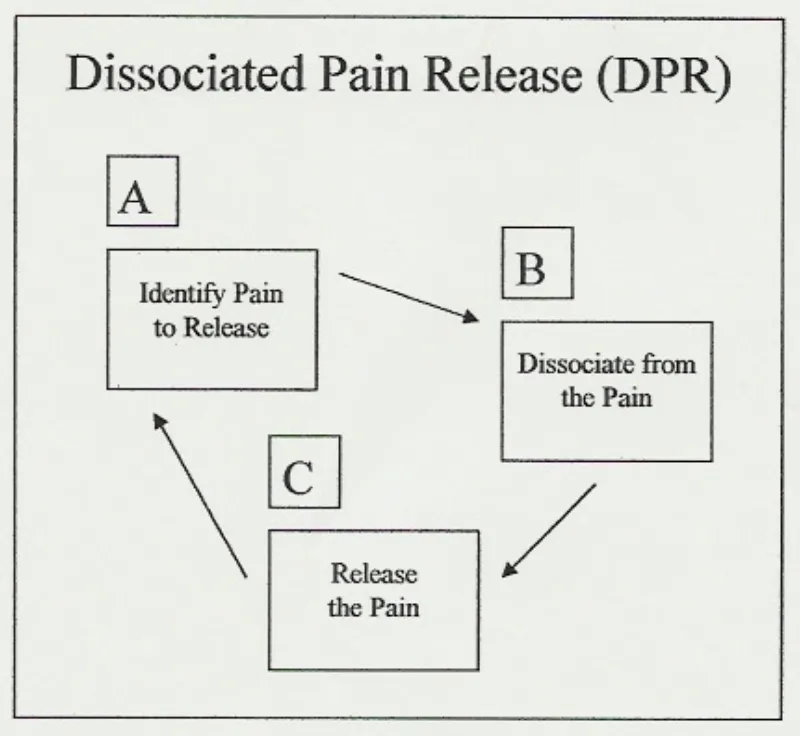
DPR has three cyclical steps: (A) identify pain to release, (B) dissociate from the pain, and (C) release the pain. Once understood, DPR is a simple, repetitive process that applies in many self-help situations. Any user employing DPR expects to complete its A-B-C cycle several times in any one self-help session. It is understood that there may be several painful emotions, different forms of physical pain and other negative bodily sensations that require release, making time and repetition necessary.
IMPORTANT
* DPR is not trauma therapy.
Anne is not a therapist and does not support individuals through trauma therapy. Anne teaches a self-help technique that individuals can apply to many situations in their everyday lives and that they have a right to use to manage any experiences they choose, traumatic or not. It is always recommended that trauma survivors hire a licensed trauma therapists whenever possible. Call 911 in any emergency.
Feeling Suicidal?
Find a Helpline

Anne MacMillan, MLA
Survivor, Consultant, Coach, Educator
Master's Clinical Psychology, Harvard Univerisity
IMPORTANT
* DPR is not trauma therapy.
Anne is not a therapist and does not support individuals through trauma therapy. Anne teaches a self-help technique that individuals can apply to many situations in their everyday lives and that they have a right to use to manage any experiences they choose, traumatic or not.
It is always recommended that trauma survivors hire a licensed trauma therapists whenever possible. Call 911 in any emergency.
Feeling Suicidal?
Find a Helpline:
https://findahelpline.com/
About Me
Like many others, I grew up in a household that didn't offer me the basic protections all children need. I experienced extreme trauma as a very young child and, unfortunately, that trauma continued into my adolescence and adulthood.
I survived adolescence emotionally by focusing on studying contemporary dance, helping me process my emotions and increase my body awareness. As a young adult in my twenties, I was exposed to relaxation and meditation techniques and the idea that healing that comes naturally when we move our eyes as we dream.
In my mid-twenties, memories of traumatic events that had happened during my early childhood began to return to my consciousness. I knew about EMDR (Eye-Movement Desensitization and Reprocessing) therapy for trauma, but wasn't in a situation that allowed me consistent access to a trauma therapist.
So, I began working through my traumatic memories on my own, combining what I'd learned about the emotions I felt in my body through dancing with relaxation and visualization techniques. I added what I decided to call REM Simulation -- or Rapid Eye Movement Simulation. REM sleep is the deep dreaming sleep in which humans naturally process emotions.
The result was a self-help technique that made it possible for me to work through the terrible emotions associated with traumatic events that had occurred in my past and regain the sense of emotional stability I needed -- all without having an opportunity to get the therapeutic support I needed.
Dissociated Pain Release
I dubbed my self-help technique DPR, or Dissociated Pain Release, and decided that I didn't want it to ever become something that anyone with an advanced degree and a lot of privilege could tell people they weren't qualified to perform at home on their own.
Therapy is wonderful and everyone who has access to a therapist should take advantage of that privilege. But recovery strategies should be available to anyone anywhere. That's what DPR is about for me.
From my perspective, DPR is nothing more than a collection of practical ideas put together in one package to help all of us get through the difficult emotions humans feel. It's valuable because it works and it uses human's natural REM (Rapid Eye Movement) sleep processing methods.

My Newest Blog Posts

Toward Mutual Intelligibility
Series V, Article 6: Toward Mutual Intelligibility
Understanding what is happening in a neurodiverse relationship, understanding it clearly and without the distorting lens of blame or pathology, is not the same as knowing what to do about it. But it is the necessary condition for knowing. The previous posts in this series have built that understanding as carefully as this framework allows: what each person's intimacy system is, what it runs on, what it offers, and what it is waiting for (Milton, 2012; Smith et al., 2021; Yew et al., 2023). This final post asks what that understanding can make possible, what becomes available to two people in a neurodiverse relationship when they genuinely understand each other's intimacy systems and commit to the translation that mutual knowing requires (Jones et al., 2024; Milton, 2012; Stafford, 2023).
Translation, Not Transformation
The goal is not transformation. It is not for the autistic partner to learn to produce the non-autistic intimacy experience, or for the non-autistic partner to stop needing the back-and-forth of emotional reciprocity that their nervous system runs on. Asking either person to become the other's kind of intimate is asking the staircase to become a spiral, and the asking itself is a harm: it requires the performance of a relational style that does not come from an authentic self, which is precisely the opposite of what intimacy is for (Milton, 2012; Sala et al., 2020; Stafford, 2023).
The goal is translation: each person developing enough genuine understanding of the other's intimacy system that the bids being made can be recognized for what they are, and responded to in ways that reach the other person as the genuine offerings they are intended to be (Jones et al., 2024; Laurenceau et al., 1998; Milton, 2012). Translation does not require that either person abandon their own intimacy architecture. It requires that each person become genuinely literate in the other's (Crompton, Sharp, et al., 2020; Milton, 2012; Smith et al., 2021).
This is hard work. It is not accomplished through goodwill alone, though goodwill is necessary. It requires specific and deliberate learning, the kind the autistic developmental pathway is well suited to, and the kind the non-autistic pathway can sustain when it understands why the learning is necessary (Sala et al., 2020; Stafford, 2023). It requires the explicit practice the previous posts described as the condition for physical intimacy to work, extended now to the full domain of what intimate life between two people requires (Stafford, 2023; Yew et al., 2023).
What the Non-Autistic Partner Can Learn to Recognize
For the non-autistic partner, translation begins with a specific relearning: what the autistic partner is offering as intimacy is intimacy, even when it does not look like the intimacy the non-autistic pathway expects to receive (Crompton, Hallett, et al., 2020; Sala et al., 2020; Smith et al., 2021).
The loyalty that does not waver. The reliability that shows up without being asked. The deep and specific knowledge of what the non-autistic partner cares about, accumulated through the concentrated engagement that the staircase organizes genuine interest around. The practical care that attends to what is needed without requiring it to be emotionally framed. The direct and unvarnished honesty that never performs a version of care it does not feel. These are not substitutes for emotional intimacy. They are a genuine form of it, offered through the channels available to a nervous system that is organized differently from the non-autistic one (Crompton, Hallett, et al., 2020; Sala et al., 2020; Smith et al., 2021; Yew et al., 2023).
Learning to receive them as what they are, rather than as insufficient approximations of what intimacy is supposed to look like, requires a specific shift in the non-autistic person's internal framework: from asking only whether the partner receives them in the way they need to be received, to also asking whether they receive their partner in the way their partner is actually offering (Jones et al., 2024; Milton, 2012; Smith et al., 2021). Both questions matter. The second is often never asked, because the non-autistic intimacy framework is so structured around the experience of being received that the experience of receiving differently is not automatically recognized as receiving at all (Laurenceau et al., 1998; Reis & Gable, 2015; Reis et al., 2017).
When Recognition Is Not Enough
Cognitive recognition of autistic intimacy bids, however genuine and however sustained, is not the same thing as having the body empathy reciprocation that the non-autistic nervous system structurally requires. This distinction matters, because it is precisely where good-faith effort in neurodiverse relationships can quietly become part of the problem rather than the resolution of it (Laurenceau et al., 1998; Reis & Gable, 2015; Reis et al., 2017).
What tends to happen over time is a recognizable pattern. The non-autistic partner learns to understand, with real effort and real sincerity, that the autistic partner's loyalty and reliability and direct care are genuine forms of intimacy. They reframe their experience accordingly and convince themselves the gap is closed. For a period, the cognitive override holds. The relationship feels manageable, even good. And then, at some point, the nervous system can no longer sustain the position the mind has taken, and there is an eruption in the relationship that neither person fully understands, because the non-autistic partner had genuinely believed they were fine. The eruption is not a sudden development. It is the accumulated cost of a body empathy reciprocation need that understanding acknowledged but could not meet (Laurenceau et al., 1998; Reis & Gable, 2015; Reis et al., 2017; Smith et al., 2021).
This means that recognition, as valuable as it is, cannot be the whole of what the non-autistic partner does with the information this series provides. It needs to be paired with an honest accounting of what the relationship actually provides and what it structurally cannot, and with the deliberate maintenance of sources of body empathy reciprocation in the non-autistic person's wider life: relationships and environments that provide the embodied emotional back-and-forth the primary partnership is not built to generate (Crompton, Sharp, et al., 2020; Milton, 2012; Smith et al., 2021; Yew et al., 2023). Not as a consolation or a compromise, but as a structural necessity for the non-autistic nervous system to remain genuinely functional within the relationship rather than periodically overwhelmed by what it has been quietly going without.
What the Autistic Partner Can Develop
For the autistic partner, translation requires something different and equally demanding: learning to recognize the intimacy function of non-autistic disclosure and reciprocity, and building the deliberate practice of responding to that function rather than only to the content (Laurenceau et al., 1998; Reis & Shaver, 1988; Sala et al., 2020).
When the non-autistic partner shares something personal, the autistic partner now has a framework for understanding what is actually being offered: not information requiring a response, but an intimacy bid requiring reception (Laurenceau et al., 1998; Reis & Gable, 2015; Reis et al., 2017). Reception does not mean the autistic partner must produce a perfectly attuned emotional response that their nervous system does not automatically generate. It means acknowledging what has been offered, naming that it has been received, and offering something in return, even if what is offered is more direct than the non-autistic intimacy framework would produce (Laurenceau et al., 1998; Milton, 2012; Sala et al., 2020). The explicit can substitute for the ambient. The deliberately offered can serve the function of the automatically given.
This is learnable. It is learned the way the staircase learns everything: through explicit information, deliberate practice, and the consolidation of genuine understanding into habit over time (Sala et al., 2020; Stafford, 2023). The autistic partner who understands that the non-autistic partner's disclosure is an intimacy bid can build the practice of responding to it as one, not through performance but through genuine effort informed by genuine understanding of what the other person's nervous system needs (Laurenceau et al., 1998; Stafford, 2023; Yew et al., 2023).
The autistic partner can also explicitly name what they themselves are offering. Saying to a partner "I looked into that thing you mentioned because I wanted to understand what matters to you" makes the intimacy function of the gesture legible to a nervous system that was not automatically registering it as an intimacy offering (Sala et al., 2020; Smith et al., 2021). Naming the offering does not diminish it. It translates it (Milton, 2012; Stafford, 2023).
The High Body Empathetic's Specific Work
For the high body empathetic, in MacMillan's theoretical framework, the specific work in the intimacy domain involves the assimilative capacity that the identity and boundary series described: staying clearly located in their own experience even in the presence of another person's powerful relational pull.
In the intimacy domain, this means something particular. The high body empathetic can become so thoroughly oriented toward receiving the autistic partner, so organized around being present to the other's experience, that their own intimacy needs recede from their own awareness. They may not know what they need, or may not be able to name it clearly, because the practice of attending to the self's own needs has been crowded out by the practice of attending to the other's (Laurenceau et al., 1998; Reis & Gable, 2015; Reis et al., 2017). The work here is recovering access to one's own intimacy needs clearly enough to name them, which is the precondition for any genuine mutual intelligibility. The non-autistic partner cannot receive what they need from a relationship whose terms they have never been able to articulate, even to themselves (Reis et al., 2017; Yew et al., 2023).
What Mutual Intelligibility Actually Looks Like
When translation is working, what it produces is not the erasure of difference. It is not a relationship that has found a way to make both people's nervous systems operate identically. It is two people who can read each other's intimacy bids well enough to receive them, who can respond in ways that reach the other person as the genuine offerings they are intended to be, and who can repair when translation fails, as it inevitably does, without interpreting the failure as evidence that the enterprise is hopeless (Jones et al., 2024; Milton, 2012; Stafford, 2023).
Repair capacity is, in some ways, the most important indicator of genuine mutual intelligibility. The couples who manage neurodiverse intimacy well are not the ones who never miss each other. They are the ones who can name the miss, understand what produced it, and find their way back to genuine contact without either person having to perform a self they are not (Stafford, 2023; Yew et al., 2023). The repair is itself an intimate act: the explicit naming of what went wrong, the genuine effort to understand the other's experience of the miss, the willingness to try again from a position of better mutual understanding (Laurenceau et al., 1998; Reis et al., 2017).
What genuinely mutual intimacy feels like across the two pathways, when it is working, may look different from what conventional intimacy frameworks would predict. It may be quieter on one side and more verbal on the other. It may involve more explicit negotiation and less ambient attunement than non-autistic-to-non-autistic intimacy typically does. It may have its own particular rhythms and rituals, built deliberately rather than arrived at through osmosis (Milton, 2012; Sala et al., 2020; Stafford, 2023). But it is real, and it is sustaining, and it produces what this series has been describing from the beginning: two distinct selves, genuinely known to each other, in genuine contact across the space that their distinctness creates (Laurenceau et al., 1998; Reis & Shaver, 1988; Yew et al., 2023).
The Honest Assessment
It would be dishonest to close this series without saying clearly: not every neurodiverse relationship can reach genuine mutual intelligibility, and not every relationship that reaches for it will sustain it. The work of translation across two fundamentally different intimacy systems is significant. It requires understanding that most couples are never given, support that the surrounding culture and clinical landscape have not yet consistently built, and a willingness to make explicit what non-autistic relationships are permitted to leave implicit (Milton, 2012; Smith et al., 2021; Stafford, 2023).
Some neurodiverse relationships will find, with genuine understanding and genuine effort, that the gap between what each person needs and what the relationship can provide is wider than either person can bridge. That is not a failure of care or a failure of character. It is an honest assessment of what a specific relational configuration can and cannot carry, and the understanding that makes that assessment possible is itself valuable, regardless of what it concludes (Smith et al., 2021; Stafford, 2023; Yew et al., 2023).
For the relationships that do find their way toward genuine mutual intelligibility, what they are building is something genuinely worth building. Not a relationship without difference, and not a relationship in which either person has had to stop being who they are in order to be close. A relationship in which two different ways of being intimate have become, through deliberate and sustained work, genuinely known to each other (Jones et al., 2024; Milton, 2012; Smith et al., 2021).
That is what genuine closeness across neurological difference looks like. And it is what makes everything that follows possible.
This post concludes Series V on Intimacy. The series continues with Series VI: Generativity and Integrity, tracing the final two movements of Erikson's developmental arc across neurotypes, exploring how the capacity for genuine closeness that intimacy builds becomes the foundation from which autistic and non-autistic people contribute something beyond themselves, and what it means, at the end of the arc, to look back on a life and find it genuinely one's own.
THE SERIES:
Article 1: What Intimacy Actually Is
Article 2: How Intimacy Forms Along the Non-Autistic Pathway
Article 3: How Intimacy Forms Along the Autistic Pathway
Article 4: Physical Intimacy, Sensory Experience and the Body
Article 5: When Two Intimacy Systems Meet
Article 6: Toward Mutual Intelligibility
Works Cited
Altman, I., & Taylor, D. A. (1973). Social penetration: The development of interpersonal relationships. Holt, Rinehart & Winston.
Crompton, C. J., Hallett, S., Ropar, D., Flynn, E., & Fletcher-Watson, S. (2020). “I never realised everybody felt as happy as I do when I am around autistic people”: A thematic analysis of autistic adults’ relationships with autistic and neurotypical friends and family. Autism, 24(6), 1438–1448. https://doi.org/10.1177/1362361320908976
Crompton, C. J., Sharp, M., Axbey, H., Fletcher-Watson, S., Flynn, E. G., & Ropar, D. (2020). Neurotype-matching, but not being autistic, influences self and observer ratings of interpersonal rapport. Frontiers in Psychology, 11, Article 586171. https://doi.org/10.3389/fpsyg.2020.586171
Jones, D. R., DeBrabander, K. M., Sasson, N. J., & Jones, M. N. (2024). Non-autistic observers both detect and demonstrate the double empathy problem when evaluating interactions between autistic and non-autistic adults. Autism, 28(4), 950–964. https://doi.org/10.1177/13623613231183085
Laurenceau, J.-P., Barrett, L. F., & Pietromonaco, P. R. (1998). Intimacy as an interpersonal process: The importance of self-disclosure, partner disclosure, and perceived partner responsiveness in interpersonal exchanges. Journal of Personality and Social Psychology, 74(5), 1238–1251. https://doi.org/10.1037/0022-3514.74.5.1238
Milton, D. E. M. (2012). On the ontological status of autism: The “double empathy problem.” Disability & Society, 27(6), 883–887. https://doi.org/10.1080/09687599.2012.710008
Reis, H. T., & Gable, S. L. (2015). Responsiveness. Current Opinion in Psychology, 1, 67–71. https://doi.org/10.1016/j.copsyc.2015.01.001
Reis, H. T., Lemay, E. P., Jr., & Finkenauer, C. (2017). Toward understanding understanding: The importance of feeling understood in relationships. Social and Personality Psychology Compass, 11(3), Article e12308. https://doi.org/10.1111/spc3.12308
Reis, H. T., & Shaver, P. (1988). Intimacy as an interpersonal process. In S. Duck, D. F. Hay, S. E. Hobfoll, W. Ickes, & B. M. Montgomery (Eds.), Handbook of personal relationships: Theory, research and interventions (pp. 367–389). Wiley.
Sala, G., Hooley, M., & Stokes, M. A. (2020). Romantic intimacy in autism: A qualitative analysis. Journal of Autism and Developmental Disorders, 50, 4133–4147. https://doi.org/10.1007/s10803-020-04377-x
Smith, R. S., Netto, J., & Lyons, G. (2021). “At the end of the day, it’s love”: An exploration of relationships in neurodiverse couples. Journal of Autism and Developmental Disorders, 51, 3311–3321. https://doi.org/10.1007/s10803-020-04790-z
Stafford, A. (2023). Relationship-counselling recommendations for partnerships involving autistic adults: A scoping review. Psychotherapy and Counselling Journal of Australia, 11(1). https://doi.org/10.59158/001c.77496
Yew, R. Y., Samuel, P., Hooley, M., Mesibov, G. B., & Stokes, M. A. (2023). Factors of relationship satisfaction for autistic and non-autistic partners in long-term relationships. Autism, 27(8), 2387–2401. https://doi.org/10.1177/13623613231160244
Understanding what is happening in a neurodiverse relationship, understanding it clearly and without the distorting lens of blame or pathology, is not the same as knowing what to do about it. But it is the necessary condition for knowing. The previous posts in this series have built that understanding as carefully as this framework allows: what each person's intimacy system is, what it runs on, what it offers, and what it is waiting for (Milton, 2012; Smith et al., 2021; Yew et al., 2023). This final post asks what that understanding can make possible, what becomes available to two people in a neurodiverse relationship when they genuinely understand each other's intimacy systems and commit to the translation that mutual knowing requires (Jones et al., 2024; Milton, 2012; Stafford, 2023).
Translation, Not Transformation
The goal is not transformation. It is not for the autistic partner to learn to produce the non-autistic intimacy experience, or for the non-autistic partner to stop needing the back-and-forth of emotional reciprocity that their nervous system runs on. Asking either person to become the other's kind of intimate is asking the staircase to become a spiral, and the asking itself is a harm: it requires the performance of a relational style that does not come from an authentic self, which is precisely the opposite of what intimacy is for (Milton, 2012; Sala et al., 2020; Stafford, 2023).
The goal is translation: each person developing enough genuine understanding of the other's intimacy system that the bids being made can be recognized for what they are, and responded to in ways that reach the other person as the genuine offerings they are intended to be (Jones et al., 2024; Laurenceau et al., 1998; Milton, 2012). Translation does not require that either person abandon their own intimacy architecture. It requires that each person become genuinely literate in the other's (Crompton, Sharp, et al., 2020; Milton, 2012; Smith et al., 2021).
This is hard work. It is not accomplished through goodwill alone, though goodwill is necessary. It requires specific and deliberate learning, the kind the autistic developmental pathway is well suited to, and the kind the non-autistic pathway can sustain when it understands why the learning is necessary (Sala et al., 2020; Stafford, 2023). It requires the explicit practice the previous posts described as the condition for physical intimacy to work, extended now to the full domain of what intimate life between two people requires (Stafford, 2023; Yew et al., 2023).
What the Non-Autistic Partner Can Learn to Recognize
For the non-autistic partner, translation begins with a specific relearning: what the autistic partner is offering as intimacy is intimacy, even when it does not look like the intimacy the non-autistic pathway expects to receive (Crompton, Hallett, et al., 2020; Sala et al., 2020; Smith et al., 2021).
The loyalty that does not waver. The reliability that shows up without being asked. The deep and specific knowledge of what the non-autistic partner cares about, accumulated through the concentrated engagement that the staircase organizes genuine interest around. The practical care that attends to what is needed without requiring it to be emotionally framed. The direct and unvarnished honesty that never performs a version of care it does not feel. These are not substitutes for emotional intimacy. They are a genuine form of it, offered through the channels available to a nervous system that is organized differently from the non-autistic one (Crompton, Hallett, et al., 2020; Sala et al., 2020; Smith et al., 2021; Yew et al., 2023).
Learning to receive them as what they are, rather than as insufficient approximations of what intimacy is supposed to look like, requires a specific shift in the non-autistic person's internal framework: from asking only whether the partner receives them in the way they need to be received, to also asking whether they receive their partner in the way their partner is actually offering (Jones et al., 2024; Milton, 2012; Smith et al., 2021). Both questions matter. The second is often never asked, because the non-autistic intimacy framework is so structured around the experience of being received that the experience of receiving differently is not automatically recognized as receiving at all (Laurenceau et al., 1998; Reis & Gable, 2015; Reis et al., 2017).
When Recognition Is Not Enough
Cognitive recognition of autistic intimacy bids, however genuine and however sustained, is not the same thing as having the body empathy reciprocation that the non-autistic nervous system structurally requires. This distinction matters, because it is precisely where good-faith effort in neurodiverse relationships can quietly become part of the problem rather than the resolution of it (Laurenceau et al., 1998; Reis & Gable, 2015; Reis et al., 2017).
What tends to happen over time is a recognizable pattern. The non-autistic partner learns to understand, with real effort and real sincerity, that the autistic partner's loyalty and reliability and direct care are genuine forms of intimacy. They reframe their experience accordingly and convince themselves the gap is closed. For a period, the cognitive override holds. The relationship feels manageable, even good. And then, at some point, the nervous system can no longer sustain the position the mind has taken, and there is an eruption in the relationship that neither person fully understands, because the non-autistic partner had genuinely believed they were fine. The eruption is not a sudden development. It is the accumulated cost of a body empathy reciprocation need that understanding acknowledged but could not meet (Laurenceau et al., 1998; Reis & Gable, 2015; Reis et al., 2017; Smith et al., 2021).
This means that recognition, as valuable as it is, cannot be the whole of what the non-autistic partner does with the information this series provides. It needs to be paired with an honest accounting of what the relationship actually provides and what it structurally cannot, and with the deliberate maintenance of sources of body empathy reciprocation in the non-autistic person's wider life: relationships and environments that provide the embodied emotional back-and-forth the primary partnership is not built to generate (Crompton, Sharp, et al., 2020; Milton, 2012; Smith et al., 2021; Yew et al., 2023). Not as a consolation or a compromise, but as a structural necessity for the non-autistic nervous system to remain genuinely functional within the relationship rather than periodically overwhelmed by what it has been quietly going without.
What the Autistic Partner Can Develop
For the autistic partner, translation requires something different and equally demanding: learning to recognize the intimacy function of non-autistic disclosure and reciprocity, and building the deliberate practice of responding to that function rather than only to the content (Laurenceau et al., 1998; Reis & Shaver, 1988; Sala et al., 2020).
When the non-autistic partner shares something personal, the autistic partner now has a framework for understanding what is actually being offered: not information requiring a response, but an intimacy bid requiring reception (Laurenceau et al., 1998; Reis & Gable, 2015; Reis et al., 2017). Reception does not mean the autistic partner must produce a perfectly attuned emotional response that their nervous system does not automatically generate. It means acknowledging what has been offered, naming that it has been received, and offering something in return, even if what is offered is more direct than the non-autistic intimacy framework would produce (Laurenceau et al., 1998; Milton, 2012; Sala et al., 2020). The explicit can substitute for the ambient. The deliberately offered can serve the function of the automatically given.
This is learnable. It is learned the way the staircase learns everything: through explicit information, deliberate practice, and the consolidation of genuine understanding into habit over time (Sala et al., 2020; Stafford, 2023). The autistic partner who understands that the non-autistic partner's disclosure is an intimacy bid can build the practice of responding to it as one, not through performance but through genuine effort informed by genuine understanding of what the other person's nervous system needs (Laurenceau et al., 1998; Stafford, 2023; Yew et al., 2023).
The autistic partner can also explicitly name what they themselves are offering. Saying to a partner "I looked into that thing you mentioned because I wanted to understand what matters to you" makes the intimacy function of the gesture legible to a nervous system that was not automatically registering it as an intimacy offering (Sala et al., 2020; Smith et al., 2021). Naming the offering does not diminish it. It translates it (Milton, 2012; Stafford, 2023).
The High Body Empathetic's Specific Work
For the high body empathetic, in MacMillan's theoretical framework, the specific work in the intimacy domain involves the assimilative capacity that the identity and boundary series described: staying clearly located in their own experience even in the presence of another person's powerful relational pull.
In the intimacy domain, this means something particular. The high body empathetic can become so thoroughly oriented toward receiving the autistic partner, so organized around being present to the other's experience, that their own intimacy needs recede from their own awareness. They may not know what they need, or may not be able to name it clearly, because the practice of attending to the self's own needs has been crowded out by the practice of attending to the other's (Laurenceau et al., 1998; Reis & Gable, 2015; Reis et al., 2017). The work here is recovering access to one's own intimacy needs clearly enough to name them, which is the precondition for any genuine mutual intelligibility. The non-autistic partner cannot receive what they need from a relationship whose terms they have never been able to articulate, even to themselves (Reis et al., 2017; Yew et al., 2023).
What Mutual Intelligibility Actually Looks Like
When translation is working, what it produces is not the erasure of difference. It is not a relationship that has found a way to make both people's nervous systems operate identically. It is two people who can read each other's intimacy bids well enough to receive them, who can respond in ways that reach the other person as the genuine offerings they are intended to be, and who can repair when translation fails, as it inevitably does, without interpreting the failure as evidence that the enterprise is hopeless (Jones et al., 2024; Milton, 2012; Stafford, 2023).
Repair capacity is, in some ways, the most important indicator of genuine mutual intelligibility. The couples who manage neurodiverse intimacy well are not the ones who never miss each other. They are the ones who can name the miss, understand what produced it, and find their way back to genuine contact without either person having to perform a self they are not (Stafford, 2023; Yew et al., 2023). The repair is itself an intimate act: the explicit naming of what went wrong, the genuine effort to understand the other's experience of the miss, the willingness to try again from a position of better mutual understanding (Laurenceau et al., 1998; Reis et al., 2017).
What genuinely mutual intimacy feels like across the two pathways, when it is working, may look different from what conventional intimacy frameworks would predict. It may be quieter on one side and more verbal on the other. It may involve more explicit negotiation and less ambient attunement than non-autistic-to-non-autistic intimacy typically does. It may have its own particular rhythms and rituals, built deliberately rather than arrived at through osmosis (Milton, 2012; Sala et al., 2020; Stafford, 2023). But it is real, and it is sustaining, and it produces what this series has been describing from the beginning: two distinct selves, genuinely known to each other, in genuine contact across the space that their distinctness creates (Laurenceau et al., 1998; Reis & Shaver, 1988; Yew et al., 2023).
The Honest Assessment
It would be dishonest to close this series without saying clearly: not every neurodiverse relationship can reach genuine mutual intelligibility, and not every relationship that reaches for it will sustain it. The work of translation across two fundamentally different intimacy systems is significant. It requires understanding that most couples are never given, support that the surrounding culture and clinical landscape have not yet consistently built, and a willingness to make explicit what non-autistic relationships are permitted to leave implicit (Milton, 2012; Smith et al., 2021; Stafford, 2023).
Some neurodiverse relationships will find, with genuine understanding and genuine effort, that the gap between what each person needs and what the relationship can provide is wider than either person can bridge. That is not a failure of care or a failure of character. It is an honest assessment of what a specific relational configuration can and cannot carry, and the understanding that makes that assessment possible is itself valuable, regardless of what it concludes (Smith et al., 2021; Stafford, 2023; Yew et al., 2023).
For the relationships that do find their way toward genuine mutual intelligibility, what they are building is something genuinely worth building. Not a relationship without difference, and not a relationship in which either person has had to stop being who they are in order to be close. A relationship in which two different ways of being intimate have become, through deliberate and sustained work, genuinely known to each other (Jones et al., 2024; Milton, 2012; Smith et al., 2021).
That is what genuine closeness across neurological difference looks like. And it is what makes everything that follows possible.
This post concludes Series V on Intimacy. The series continues with Series VI: Generativity and Integrity, tracing the final two movements of Erikson's developmental arc across neurotypes, exploring how the capacity for genuine closeness that intimacy builds becomes the foundation from which autistic and non-autistic people contribute something beyond themselves, and what it means, at the end of the arc, to look back on a life and find it genuinely one's own.
References
Crompton, C. J., Hallett, S., Ropar, D., Flynn, E. G., & Fletcher-Watson, S. (2020). “I never realised everybody felt as happy as I do when I am around autistic people”: A thematic analysis of autistic adults’ relationships with autistic and neurotypical friends and family. Autism, 24(6), 1438–1448. https://doi.org/10.1177/1362361320908976
Crompton, C. J., Sharp, M., Axbey, H., Fletcher-Watson, S., Flynn, E. G., & Ropar, D. (2020). Neurotype-matching, but not being autistic, influences self and observer ratings of interpersonal rapport. Frontiers in Psychology, 11, Article 586171. https://doi.org/10.3389/fpsyg.2020.586171
Jones, D. R., Botha, M., Ackerman, R. A., King, K., & Sasson, N. J. (2024). Non-autistic observers both detect and demonstrate the double empathy problem when evaluating interactions between autistic and non-autistic adults. Autism, 28(8), 2053–2065. https://doi.org/10.1177/13623613231219743
Laurenceau, J.-P., Barrett, L. F., & Pietromonaco, P. R. (1998). Intimacy as an interpersonal process: The importance of self-disclosure, partner disclosure, and perceived partner responsiveness in interpersonal exchanges. Journal of Personality and Social Psychology, 74(5), 1238–1251. https://doi.org/10.1037/0022-3514.74.5.1238
Milton, D. E. M. (2012). On the ontological status of autism: The “double empathy problem.” Disability & Society, 27(6), 883–887. https://doi.org/10.1080/09687599.2012.710008
Reis, H. T., & Gable, S. L. (2015). Responsiveness. Current Opinion in Psychology, 1, 67–71. https://doi.org/10.1016/j.copsyc.2015.01.001
Reis, H. T., Lemay, E. P., Jr., & Finkenauer, C. (2017). Toward understanding understanding: The importance of feeling understood in relationships. Social and Personality Psychology Compass, 11(3), Article e12308. https://doi.org/10.1111/spc3.12308
Reis, H. T., & Shaver, P. (1988). Intimacy as an interpersonal process. In S. Duck, D. F. Hay, S. E. Hobfoll, W. Ickes, & B. M. Montgomery (Eds.), Handbook of personal relationships: Theory, research and interventions (pp. 367–389). Wiley.
Sala, G., Hooley, M., & Stokes, M. A. (2020). Romantic intimacy in autism: A qualitative analysis. Journal of Autism and Developmental Disorders, 50, 4133–4147. https://doi.org/10.1007/s10803-020-04377-x
Smith, R., Netto, J., Gribble, N. C., & Falkmer, M. (2021). “At the end of the day, it’s love”: An exploration of relationships in neurodiverse couples. Journal of Autism and Developmental Disorders, 51(9), 3311–3321. https://doi.org/10.1007/s10803-020-04790-z
Stafford, A. (2023). Relationship-counselling recommendations for partnerships involving autistic adults: A scoping review. Psychotherapy and Counselling Journal of Australia, 11(1). https://doi.org/10.59158/001c.77496
Yew, R. Y., Hooley, M., & Stokes, M. A. (2023). Factors of relationship satisfaction for autistic and non-autistic partners in long-term relationships. Autism, 27(8), 2348–2360. https://doi.org/10.1177/13623613231160244
© 2023 REAL Neurodiverse
All Rights Reserved
anne@neurodiversemarriage.com
Text or Call: (617) 996-7239 (United States)