DPR
Dissociated Pain Release
A self-help technique developed by a trauma survivor

Anne MacMillan, MLA
Survivor, Consultant, Coach
Master's Clinical Psychology - Harvard University
Dissociated Pain Release
Self-Help Trauma Support
Dissociated Pain Release
Dissociated Pain Release (DPR) is a self-help technique that allows users to release emotional pain from trauma without re-experiencing it. It is based on the idea that emotional pain is stored in the mind, body, and nervous system and that the stored pain causes distress and discomfort in the present, whether the trauma was a recent event or something that happened many years ago.
There is no need for a DPR user to know where any emotional pain came from. All a user needs to know is that they are currently experiencing unwanted emotional pain and that they would like to release that pain and feel better -- quickly.
Most importantly, in DPR, emotional pains are released while the user is dissociated from them -- allowing the user to process any trauma or distress without being forced to relive the original traumatic experience.
Examples of emotional pain that can be released from the body and nervous system through DPR include rage, anger, shame, sadness, guilt, grief, loneliness, abandonment, anxiety, and fear.
Likewise, DRP allows users to release any stored sensations associated with physical pain or forms of bodily discomfort that happened in the past. DPR users can release sensations of nausea, dizziness, cold, being drugged, etc. Again, all these sensations are released without the DRP user re-experiencing the original potency of any traumatic event. Often DPR users release pain without even knowing what the original traumatic event may have been.
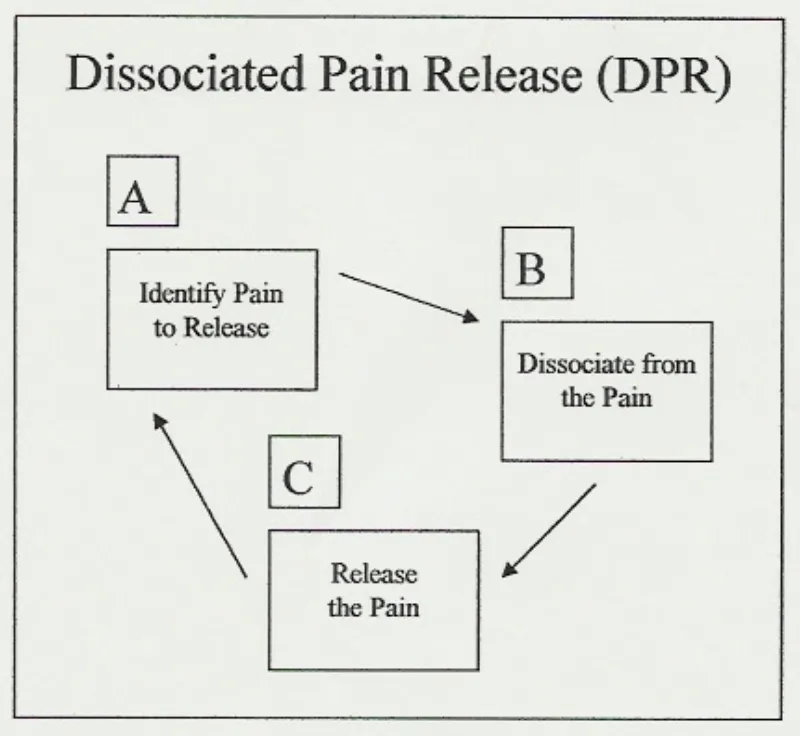
DPR has three cyclical steps: (A) identify pain to release, (B) dissociate from the pain, and (C) release the pain. Once understood, DPR is a simple, repetitive process that applies in many self-help situations. Any user employing DPR expects to complete its A-B-C cycle several times in any one self-help session. It is understood that there may be several painful emotions, different forms of physical pain and other negative bodily sensations that require release, making time and repetition necessary.
IMPORTANT
* DPR is not trauma therapy.
Anne is not a therapist and does not support individuals through trauma therapy. Anne teaches a self-help technique that individuals can apply to many situations in their everyday lives and that they have a right to use to manage any experiences they choose, traumatic or not. It is always recommended that trauma survivors hire a licensed trauma therapists whenever possible. Call 911 in any emergency.
Feeling Suicidal?
Find a Helpline

Anne MacMillan, MLA
Survivor, Consultant, Coach, Educator
Master's Clinical Psychology, Harvard Univerisity
IMPORTANT
* DPR is not trauma therapy.
Anne is not a therapist and does not support individuals through trauma therapy. Anne teaches a self-help technique that individuals can apply to many situations in their everyday lives and that they have a right to use to manage any experiences they choose, traumatic or not.
It is always recommended that trauma survivors hire a licensed trauma therapists whenever possible. Call 911 in any emergency.
Feeling Suicidal?
Find a Helpline:
https://findahelpline.com/
About Me
Like many others, I grew up in a household that didn't offer me the basic protections all children need. I experienced extreme trauma as a very young child and, unfortunately, that trauma continued into my adolescence and adulthood.
I survived adolescence emotionally by focusing on studying contemporary dance, helping me process my emotions and increase my body awareness. As a young adult in my twenties, I was exposed to relaxation and meditation techniques and the idea that healing that comes naturally when we move our eyes as we dream.
In my mid-twenties, memories of traumatic events that had happened during my early childhood began to return to my consciousness. I knew about EMDR (Eye-Movement Desensitization and Reprocessing) therapy for trauma, but wasn't in a situation that allowed me consistent access to a trauma therapist.
So, I began working through my traumatic memories on my own, combining what I'd learned about the emotions I felt in my body through dancing with relaxation and visualization techniques. I added what I decided to call REM Simulation -- or Rapid Eye Movement Simulation. REM sleep is the deep dreaming sleep in which humans naturally process emotions.
The result was a self-help technique that made it possible for me to work through the terrible emotions associated with traumatic events that had occurred in my past and regain the sense of emotional stability I needed -- all without having an opportunity to get the therapeutic support I needed.
Dissociated Pain Release
I dubbed my self-help technique DPR, or Dissociated Pain Release, and decided that I didn't want it to ever become something that anyone with an advanced degree and a lot of privilege could tell people they weren't qualified to perform at home on their own.
Therapy is wonderful and everyone who has access to a therapist should take advantage of that privilege. But recovery strategies should be available to anyone anywhere. That's what DPR is about for me.
From my perspective, DPR is nothing more than a collection of practical ideas put together in one package to help all of us get through the difficult emotions humans feel. It's valuable because it works and it uses human's natural REM (Rapid Eye Movement) sleep processing methods.

My Newest Blog Posts

The Destination Is the Same: Erikson's Full Arc Across Neurologies
There is something quietly radical about ending a series on developmental difference by insisting on a shared destination. We have spent four posts documenting how different the paths are: different feedback mechanisms, different movement patterns, different structural requirements, different vulnerabilities. The differences are real and they matter. Minimizing them would betray everything this framework is trying to do.
And yet.
Every human being who has ever lived has been engaged in the same fundamental project. The project of becoming. Of moving, however haltingly, however nonlinearly, however differently, toward a life that feels coherent, connected, and worth having lived. Erik Erikson mapped that project in eight stages, and whatever its limitations as a framework built without neurodiversity in mind, its destinations remain among the most honest and complete descriptions of what human beings are actually reaching for across a lifetime (Erikson, 1963, 1980).
This final post is about those destinations. About what it means to reach them by different routes. And about what it would look like to build a world where both routes are genuinely supported all the way to the end.
The Full Arc
Erikson's eight stages are not a checklist. They are a portrait of the human project in motion, each stage building on the ones before it, each quality earned through the particular struggle that stage requires (Erikson, 1963, 1980).
In infancy, the task is trust. The experience of being reliably cared for, of having needs met consistently enough that the world begins to feel like a place where safety is possible. For non-autistic infants, this trust is built partly through the embodied back-and-forth of facial communication, vocalization, and mutual gaze. For autistic infants, the same trust needs to be built, but the channels through which it is communicated and received may look different. When the caregiving environment understands this, trust can form. When it does not, the developmental journey begins on uncertain ground.
Autonomy follows, the toddler's emerging sense that they are a separate being with their own will and their own capacity to act in the world. For autistic children, autonomy has a particular texture. The strong relationship with one's own perspective that characterizes autistic experience can be the foundation of a profound and stable autonomy, when it is respected rather than pathologized. When the environment responds to autistic autonomy as defiance or rigidity rather than as the genuine selfhood it often is, the developmental message received is that the self is wrong. That message echoes forward through every subsequent stage.
Initiative and industry follow: the child reaching outward, trying things, discovering competence, building the sense that their efforts produce results in the world. For autistic children, these stages are where the quality of the holding environment becomes particularly consequential (Kegan, 1982; Winnicott, 1965). The explicit, calibrated feedback that the staircase needs is precisely what allows initiative to become industry, allows trying to become knowing, allows the child to build a genuine sense of their own capability rather than a performed approximation of someone else's.
And then identity. The adolescent task of pulling together everything that has come before into a coherent sense of who one is and how one belongs to the world. This is the stage where the absence of appropriate developmental scaffolding for autistic people has perhaps the most visible consequences. Research by Davies and colleagues and Cooper and colleagues confirms what many autistic adults know from the inside: positive autistic identity is not a given. It is an achievement, and it is an achievement that depends heavily on the quality of acceptance and support the environment has provided (Cooper et al., 2023; Davies et al., 2024). When that support has been absent, when the message received across childhood has been that the authentic self is too much, too different, too wrong, identity formation in adolescence becomes an excavation rather than a consolidation. The autistic person is not building on a foundation. They are searching for one.
The Adult Stages and Why They Matter
Erikson's adult stages have received less attention in the autism literature than the childhood stages, and this is a significant gap. Autism has too often been treated as primarily a childhood concern, something to be intervened upon early and then managed across adulthood. The lifespan developmental framework that Ommensen and colleagues called for in 2026 pushes back against this directly (Ommensen et al., 2026). Autistic development does not plateau at eighteen. The adult stages matter, and they are where the consequences of earlier developmental support or its absence become most fully visible.
Intimacy, Erikson's sixth stage, is the young adult task of genuine closeness with another person. Not proximity. Not cohabitation. The experience of being truly known by another and of truly knowing them, of allowing the self to be vulnerable in the presence of another without losing the self in the process. For autistic adults, intimacy is one of the most frequently cited sources of both longing and difficulty. Grace and colleagues found that loneliness in autistic adults is widespread, persistent, and deeply connected to the absence of understanding and acceptance in their relational environments (Grace et al., 2022). Autistic adults want intimacy. The developmental framework that would have supported them in building toward it across childhood and adolescence has largely not existed.
This is not destiny. Scheeren and colleagues followed more than nine hundred autistic adults for six years and found measurable improvement in psychosocial functioning and wellbeing over time (Scheeren et al., 2022). The staircase rises. Even without ideal developmental conditions in the earlier stages, even carrying the weight of inadequate holding environments across childhood and adolescence, autistic adults continue to develop. The journey does not end. But it is harder, and longer, and lonelier than it needs to be, and that is a choice we are making as a society, not an inevitability written into autistic neurology.
Generativity, Erikson's seventh stage, is the midlife task of contributing something beyond the self. Of caring for the next generation, broadly understood: through parenting, through mentorship, through creative work, through any act that extends one's care and knowledge outward into the world. Autistic adults are capable of profound generativity. The intense interests, the deep expertise, the capacity for focused and sustained engagement that characterize autistic experience are exactly the qualities from which meaningful contribution is made. What gets in the way is not autistic neurology. It is the accumulated exhaustion of navigating a world that has not been built for the staircase, the energy spent on camouflaging and compensating and surviving environments calibrated for the spiral, energy that could otherwise have gone into the generative work the autistic person is often uniquely positioned to do (Cage & Troxell-Whitman, 2019; Hull et al., 2017).
And finally, integrity. Erikson's eighth stage, the late life task of looking back on one's life and finding in it a sense of coherence and meaning. Not perfection. Not the absence of suffering or failure or loss. But the sense that the life was genuinely lived, that it belonged to the person who lived it, that it added up to something.
This is what the whole framework is reaching toward. For every person, regardless of neurology. The spiral and the staircase are both trying to get here. They have always been trying to get here.
What It Would Mean to Actually Support Both
MacMillan's Spiral and Staircase Model™ is not primarily a descriptive theory. It is a generative one. It exists not just to explain what has happened but to point toward what could happen differently.
What would it mean to actually support both paths across the full arc of a life?
It would mean building holding environments from the beginning that understand what each neurotype actually needs (Kegan, 1982; Winnicott, 1965). Infants and toddlers and school-age children and adolescents held in ways calibrated to their neurology, neither required to perform the other path nor abandoned to navigate their own path without guidance or support.
It would mean understanding that the horizontal surfaces of the staircase are not failures of development but necessary phases of consolidation, and responding to them with patience and continued presence rather than increased pressure or withdrawal.
It would mean building educational environments that offer the explicit, clear, sequentially structured feedback the staircase runs on, not as a special accommodation reluctantly granted, but as a basic feature of how learning is organized for autistic students.
It would mean clinical practice that understands autistic development as a lifespan process, that supports autistic adults in the work of identity, intimacy, and generativity rather than treating adulthood as the point at which developmental support ends (Ommensen et al., 2026).
It would mean relationships, between autistic and non-autistic people, built on genuine understanding of what each person's neurology requires, rather than the unspoken and usually unconscious demand that the autistic person perform the spiral while the non-autistic person quietly accommodates the staircase until they can no longer sustain it (Milton, 2012).
And it would mean, perhaps most fundamentally, a cultural shift in how autism is understood. Not as a disorder to be corrected. Not as a difference to be celebrated in ways that deny its real challenges. But as a different developmental pathway, with its own logic, its own strengths, its own particular requirements, and its own full and equal access to the human project of becoming (Milton, 2012).
The Same Destination
The spiral moves through the world with continuous embodied feedback, curving outward and back, outward and back, self-correcting, oscillating upward toward trust and autonomy and identity and intimacy and generativity and integrity.
The staircase moves through the world in concentrated, sequential steps, rising and consolidating, rising and consolidating, dependent on the quality of the environment around it, reaching toward the same destinations by a different route.
Neither path is the default. Neither is the variation. They are two expressions of the same human drive, the drive toward coherence, toward connection, toward a life that belongs to the person living it.
Both deserve to be understood. Both deserve to be held. Both deserve to arrive.
This post concludes the first series on MacMillan's Spiral and Staircase Model™ of psychosocial development across neurologies. The series continues with an exploration of how these developmental pathways shape the specific domains of human relationship: boundaries, identity, attachment, intimacy, and beyond.
Post 1. The Gap: Why Developmental Psychology has Never Fully Accounted for Autism
Post 2. The Engine of Development: What Growth Requires Across all Neurologies
Post 3. Two Paths Upward: MacMillan's Spiral and Staircase Models of Psychosocial Development
Post 4. The Holding Environment: What Development Actually Requires
Post 5. The Destination is the Same: Erikson's Full Arc Across Neurologies
References
Cage, E., & Troxell-Whitman, Z. (2019). Understanding the reasons, contexts and costs of camouflaging for autistic adults. Journal of Autism and Developmental Disorders, 49(5), 1899–1911. https://doi.org/10.1007/s10803-018-03878-x
Cooper, K., Smith, L. G. E., & Russell, A. J. (2023). The impact of a positive autism identity and autistic community solidarity on social anxiety and mental health in autistic young people. Autism, 27(3), 848–857. https://doi.org/10.1177/13623613221118351
Davies, J., Cooper, K., Killick, E., Sam, E., Healy, M., Thompson, G., Mandy, W., Redmayne, B., & Crane, L. (2024). Autistic identity: A systematic review of quantitative research. Autism Research, 17(5), 874–897. https://doi.org/10.1002/aur.3105
Erikson, E. H. (1963). Childhood and society (2nd ed.). W. W. Norton.
Erikson, E. H. (1980). Identity and the life cycle. W. W. Norton.
Grace, K., Remington, A., Lloyd-Evans, B., Davies, J., & Crane, L. (2022). Loneliness in autistic adults: A systematic review. Autism, 26(8), 2117–2135. https://doi.org/10.1177/13623613221077721
Hull, L., Petrides, K. V., Allison, C., Smith, P., Baron-Cohen, S., Lai, M.-C., & Mandy, W. (2017). “Putting on my best normal”: Social camouflaging in adults with autism spectrum conditions. Journal of Autism and Developmental Disorders, 47(8), 2519–2534. https://doi.org/10.1007/s10803-017-3166-5
Kegan, R. (1982). The evolving self: Problem and process in human development. Harvard University Press.
Milton, D. E. M. (2012). On the ontological status of autism: The “double empathy problem.” Disability & Society, 27(6), 883–887. https://doi.org/10.1080/09687599.2012.710008
Ommensen, B., Attwood, T., Pachana, N. A., & Sofronoff, K. (2026). The potential for successful autistic ageing: Proposing a lifespan developmental psychology approach. Autism. https://doi.org/10.1177/13623613261418468
Scheeren, A. M., Buil, J. M., Howlin, P., Bartels, M., & Begeer, S. (2022). Objective and subjective psychosocial outcomes in adults with autism spectrum disorder: A 6-year longitudinal study. Autism, 26(1), 243–255. https://doi.org/10.1177/13623613211027673
Winnicott, D. W. (1965). The maturational processes and the facilitating environment: Studies in the theory of emotional development. International Universities Press.
© 2023 REAL Neurodiverse
All Rights Reserved
anne@neurodiversemarriage.com
Text or Call: (617) 996-7239 (United States)