DPR
Dissociated Pain Release
A self-help technique developed by a trauma survivor

Anne MacMillan, MLA
Survivor, Consultant, Coach
Master's Clinical Psychology - Harvard University
Dissociated Pain Release
Self-Help Trauma Support
Dissociated Pain Release
Dissociated Pain Release (DPR) is a self-help technique that allows users to release emotional pain from trauma without re-experiencing it. It is based on the idea that emotional pain is stored in the mind, body, and nervous system and that the stored pain causes distress and discomfort in the present, whether the trauma was a recent event or something that happened many years ago.
There is no need for a DPR user to know where any emotional pain came from. All a user needs to know is that they are currently experiencing unwanted emotional pain and that they would like to release that pain and feel better -- quickly.
Most importantly, in DPR, emotional pains are released while the user is dissociated from them -- allowing the user to process any trauma or distress without being forced to relive the original traumatic experience.
Examples of emotional pain that can be released from the body and nervous system through DPR include rage, anger, shame, sadness, guilt, grief, loneliness, abandonment, anxiety, and fear.
Likewise, DRP allows users to release any stored sensations associated with physical pain or forms of bodily discomfort that happened in the past. DPR users can release sensations of nausea, dizziness, cold, being drugged, etc. Again, all these sensations are released without the DRP user re-experiencing the original potency of any traumatic event. Often DPR users release pain without even knowing what the original traumatic event may have been.
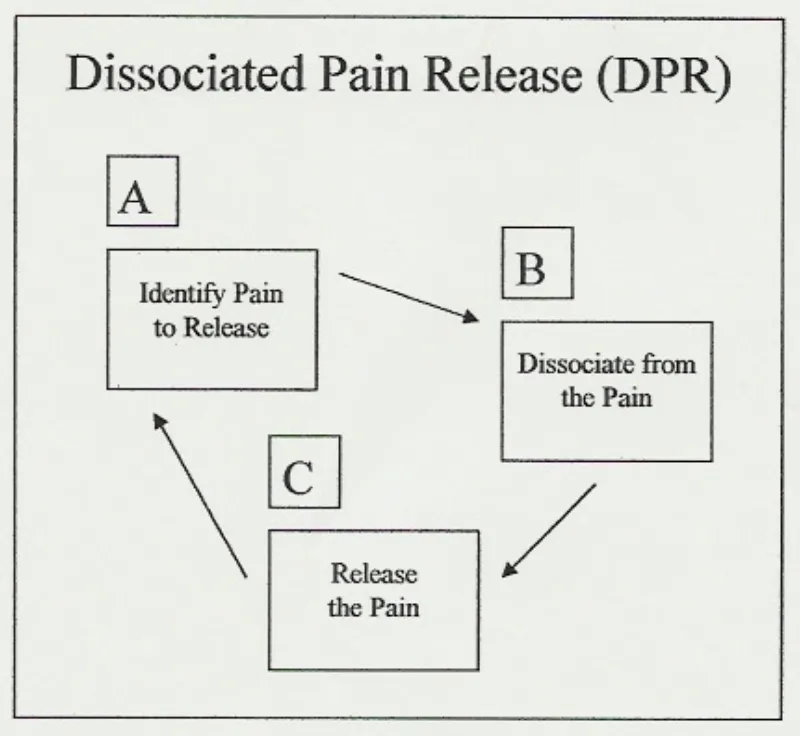
DPR has three cyclical steps: (A) identify pain to release, (B) dissociate from the pain, and (C) release the pain. Once understood, DPR is a simple, repetitive process that applies in many self-help situations. Any user employing DPR expects to complete its A-B-C cycle several times in any one self-help session. It is understood that there may be several painful emotions, different forms of physical pain and other negative bodily sensations that require release, making time and repetition necessary.
IMPORTANT
* DPR is not trauma therapy.
Anne is not a therapist and does not support individuals through trauma therapy. Anne teaches a self-help technique that individuals can apply to many situations in their everyday lives and that they have a right to use to manage any experiences they choose, traumatic or not. It is always recommended that trauma survivors hire a licensed trauma therapists whenever possible. Call 911 in any emergency.
Feeling Suicidal?
Find a Helpline

Anne MacMillan, MLA
Survivor, Consultant, Coach, Educator
Master's Clinical Psychology, Harvard Univerisity
IMPORTANT
* DPR is not trauma therapy.
Anne is not a therapist and does not support individuals through trauma therapy. Anne teaches a self-help technique that individuals can apply to many situations in their everyday lives and that they have a right to use to manage any experiences they choose, traumatic or not.
It is always recommended that trauma survivors hire a licensed trauma therapists whenever possible. Call 911 in any emergency.
Feeling Suicidal?
Find a Helpline:
https://findahelpline.com/
About Me
Like many others, I grew up in a household that didn't offer me the basic protections all children need. I experienced extreme trauma as a very young child and, unfortunately, that trauma continued into my adolescence and adulthood.
I survived adolescence emotionally by focusing on studying contemporary dance, helping me process my emotions and increase my body awareness. As a young adult in my twenties, I was exposed to relaxation and meditation techniques and the idea that healing that comes naturally when we move our eyes as we dream.
In my mid-twenties, memories of traumatic events that had happened during my early childhood began to return to my consciousness. I knew about EMDR (Eye-Movement Desensitization and Reprocessing) therapy for trauma, but wasn't in a situation that allowed me consistent access to a trauma therapist.
So, I began working through my traumatic memories on my own, combining what I'd learned about the emotions I felt in my body through dancing with relaxation and visualization techniques. I added what I decided to call REM Simulation -- or Rapid Eye Movement Simulation. REM sleep is the deep dreaming sleep in which humans naturally process emotions.
The result was a self-help technique that made it possible for me to work through the terrible emotions associated with traumatic events that had occurred in my past and regain the sense of emotional stability I needed -- all without having an opportunity to get the therapeutic support I needed.
Dissociated Pain Release
I dubbed my self-help technique DPR, or Dissociated Pain Release, and decided that I didn't want it to ever become something that anyone with an advanced degree and a lot of privilege could tell people they weren't qualified to perform at home on their own.
Therapy is wonderful and everyone who has access to a therapist should take advantage of that privilege. But recovery strategies should be available to anyone anywhere. That's what DPR is about for me.
From my perspective, DPR is nothing more than a collection of practical ideas put together in one package to help all of us get through the difficult emotions humans feel. It's valuable because it works and it uses human's natural REM (Rapid Eye Movement) sleep processing methods.

My Newest Blog Posts

The Oscillation That Rises: Identity Formation in Non-Autistic Development
Series IV, Article 2: The Oscillation That Rises: Identity Formation in Non-Autistic Development
People whose development follows the non-autistic pathway move through the world in a particular rhythm. They go forward with some working confidence in their current understanding of themselves, meet experience that either confirms or challenges that understanding, and curve back to integrate what came back before moving forward again. That oscillating motion, repeated across thousands of encounters over years of development, is what gives the non-autistic developmental pathway its spiral shape: not a straight line upward, but a continuous back-and-forth that rises with each cycle (Piaget, 1952).
At every stage of the developmental journey, that oscillation is turning on a different question. The trust stage turned on whether the world was safe enough to rely on. The autonomy stage turned on whether the self was allowed to choose. The identity stage turns on something both harder and more foundational: who the self actually is, and whether it can be recognized as continuously itself across time and context (Erikson, 1968; McAdams, 2001; McAdams & McLean, 2013).
The Oscillation and How It Builds a Self
Piaget called the two movements of this engine assimilation and accommodation: the self encounters new experience and either integrates it into its existing understanding of the world or reorganizes that understanding to make room for it (Piaget, 1952). Baumrind identified the environmental conditions that keep the engine running well: responsiveness and demandingness held simultaneously, warmth alongside genuine expectation (Baumrind, 1971, 1991; Darling & Steinberg, 1993; Maccoby & Martin, 1983). Csikszentmihalyi described what the oscillation feels like from the inside: the relationship between challenge and ability shifts constantly, moving through stretches when ability outpaces the challenge at hand and the self moves forward with ease and confidence, and stretches when challenge outpaces ability and the self is pressed back into self-doubt and reorganization (Csikszentmihalyi, 1990). In the narrow space where the two are nearly balanced, with challenge slightly exceeding current ability and feedback arriving quickly enough to be useful, growth is most productive (Csikszentmihalyi, 1990). But that channel is not a destination. It is a moment in the oscillation, and the oscillation moves through the full range, confidence and self-doubt, ease and difficulty, on its way upward.
Applied to identity formation, these movements take on a specific character. The forward, assimilative movement is the person acting from their current understanding of who they are, bringing that working self-concept into genuine contact with the world. The curve back, the accommodative movement, is what happens when the world responds in a way that does not quite fit: the person pauses, absorbs the discrepancy, reorganizes their understanding of themselves, and moves forward again with a slightly more coherent picture of who they actually are (Marcia, 1966; McAdams, 2001; McAdams & McLean, 2013; Piaget, 1952). Carried out across thousands of encounters over years of development, this oscillation is what produces what Erikson called self-sameness: the felt continuity of being recognizably oneself even while changing and growing (Erikson, 1968).
Neither movement alone is sufficient. A person whose development has been dominated by assimilation, who integrates new experience without genuine reorganization, builds a self-concept that becomes rigid over time, impervious to the encounters that would most develop it. A person whose development has been dominated by accommodation, who reorganizes readily around whatever the social environment most recently offered, loses their own ground. Their self-concept becomes difficult to locate consistently across time and context, which is the opposite of what identity formation is trying to achieve (Erikson, 1968; Marcia, 1966; McAdams & McLean, 2013; Piaget, 1952). The oscillation needs both movements, completed genuinely, to produce a self that holds together.
What Keeps the Oscillation Going
For people moving through the non-autistic developmental pathway, body empathy, MacMillan's term for the immediate, embodied, interoceptive, largely automatic reception of social information from the faces and bodies of others, is what keeps this oscillation continuously fed. Because the non-autistic nervous system is registering in real time how it is being received by the people around it, the feedback loop between self-concept and social reality never stops. Each encounter provides data. The self-concept updates. The oscillation keeps moving (Craig, 2009; Critchley et al., 2004; Decety & Jackson, 2004; Gallese, 2009; Niedenthal, 2007).
This is a genuine strength. The self-concept that forms through continuous oscillation is not a fixed thing built once and preserved. It is a living structure, refined by every significant encounter, calibrated and recalibrated across a lifetime of social experience. The feedback that keeps the loop running does not have to be requested or waited for. It arrives automatically, below conscious awareness, and gets integrated without requiring deliberate processing. The self is always, in some sense, in conversation with the social world around it (McAdams & McLean, 2013; Pfeifer & Berkman, 2018; Ragelienė, 2016; Yue et al., 2020).
The quality of what arrives in that conversation matters greatly. Feedback shaped by neurotype bias, by conditional acceptance, or by environments not designed to receive this particular person accurately produces a self-concept built from distorted raw material. The person has not failed to develop an identity. They have developed one calibrated to inaccurate information, which is a specific kind of problem and genuinely difficult to recognize from the inside, because the feedback loop itself does not distinguish between accurate and distorted input. It simply integrates what it receives (Erikson, 1968; McAdams, 2001; McAdams & McLean, 2013; Yue et al., 2020).
When Accommodation Runs the Show
Within the range of people whose development follows the non-autistic pathway, there is real variation in how strongly each half of the oscillation runs. MacMillan's theoretical framework, offered here as theory in need of future empirical investigation, proposes that at the high end of this variation are people whose accommodation mechanism is exceptionally strong.
The people MacMillan terms high body empathetics experience others' states with unusual vividness and immediacy. Their embodied simulation and interoceptive sensitivity and awareness operate at high levels, which means stepping into another person's perspective is not so much a chosen act as a structural tendency of the nervous system: something that happens readily, often before it has been consciously decided (Craig, 2009; Critchley et al., 2004; Decety & Jackson, 2004; Gallese, 2009; Lamm et al., 2007; Singer et al., 2004). This is one of the most genuinely valuable capacities a person can bring to a relationship. The ability to inhabit another's experience rather than simply observing it from the outside is the foundation of real attunement rather than performed sympathy (Decety & Jackson, 2004; Lamm et al., 2007; Niedenthal, 2007; Singer et al., 2004).
The identity challenge that accompanies it is equally genuine. When accommodation runs strongly, when the oscillation reorganizes readily around whatever perspective is most powerfully present in the relational field, the assimilative movement requires more deliberate effort than the nervous system's natural pull provides. Staying in one's own shoes, moving forward from one's own self-concept rather than from the perspective of the person currently being inhabited, becomes something that has to be worked at. The oscillation keeps curving back, but it curves past its own center and into the territory of whoever else is present (Erikson, 1968; Marcia, 1966; McAdams & McLean, 2013).
Over time, across many cycles in which accommodation has dominated, the self-concept can become genuinely uncertain. Not because the high body empathetic lacks a self, but because the oscillation has not been completing the full cycle in both directions. They know others' worlds well and have had considerably less practice holding their own perspective clearly, as their own, in the presence of another person whose experience the nervous system is already inhabiting (Erikson, 1968; Marcia, 1966; McAdams, 2001; McAdams & McLean, 2013).
The developmental work is not about reducing the attunement. The attunement is not the problem. The work is building the assimilative side of the oscillation to match the accommodative one: learning to stay grounded in one's own experience while genuinely taking in others', to bring another's world into contact with one's own self-concept rather than dissolving the self-concept into it. This is specific work that therapeutic and developmental frameworks have rarely named clearly, because the neurological architecture that creates the challenge has not yet been adequately described. MacMillan's framework is an attempt to begin that description (Decety & Jackson, 2004; Erikson, 1968; Lamm et al., 2007; Marcia, 1966).
What the Oscillation Needs
What the oscillation needs to build identity well is what it needs at every stage: accurate feedback, genuine challenge, and the freedom to complete both movements without the environment resolving the tension prematurely in either direction (Baumrind, 1971, 1991; Csikszentmihalyi, 1990; Darling & Steinberg, 1993; Piaget, 1952). For people on the non-autistic pathway, this means social environments that reflect who the person actually is rather than a neurotype-biased approximation, relationships that offer genuine encounter rather than managed distance, and enough of the right kind of social contact that the oscillation is being fed with accurate rather than distorted information (Pfeifer & Berkman, 2018; Ragelienė, 2016; Yue et al., 2020).
For the high body empathetic, it means relationships and environments that actively support the assimilative movement: that reflect the high body empathetic's own perspective back with enough clarity and consistency that there is something solid to move forward from. The oscillation needs both directions to rise. The direction that needs most intentional support is the one the nervous system does not already supply on its own (Erikson, 1968; Marcia, 1966; McAdams & McLean, 2013; Piaget, 1952).
The autistic developmental pathway does not move through this oscillation in the same way. It does not run on the continuous social feedback loop that body empathy provides, and identity does not form through the same back-and-forth rhythm. It builds through a different structure, at a different pace, under conditions that the environments autistic people move through have rarely been designed to provide. What that structure is, what it requires, and what disrupts it, is what the next post examines.
Next in this series: The Staircase that Rises — Identity Formation in Autistic Development, how the staircase pathway approaches the question of who the self is, the specific conditions that allow that question to be answered well, and why the authentic self can become genuinely difficult to locate after years of moving through environments that required a different self to be shown.
THE SERIES
Article 1: Identity — The Fifth Task
Article 2: The Oscillation that Rises — Identity Formation in Non-Autistic Development
Article 3: The Staircase that Rises — Identity Formation in Autistic Development
Article 4: When the Self is Finally Named
Article 5: Neurodiverse Relationships — Two Selves, One Room
Article 6: The Self that Knows Where it Stands
Works Cited
Baumrind, D. (1971). Current patterns of parental authority. Developmental Psychology, 4(1, Pt. 2), 1–103. https://doi.org/10.1037/h0030372
Baumrind, D. (1991). The influence of parenting style on adolescent competence and substance use. The Journal of Early Adolescence, 11(1), 56–95. https://doi.org/10.1177/0272431691111004
Craig, A. D. (2009). How do you feel—now? The anterior insula and human awareness. Nature Reviews Neuroscience, 10(1), 59–70. https://doi.org/10.1038/nrn2555
Critchley, H. D., Wiens, S., Rotshtein, P., Öhman, A., & Dolan, R. J. (2004). Neural systems supporting interoceptive awareness. Nature Neuroscience, 7(2), 189–195. https://doi.org/10.1038/nn1176
Csikszentmihalyi, M. (1990). Flow: The psychology of optimal experience. Harper & Row.
Darling, N., & Steinberg, L. (1993). Parenting style as context: An integrative model. Psychological Bulletin, 113(3), 487–496. https://doi.org/10.1037/0033-2909.113.3.487
Decety, J., & Jackson, P. L. (2004). The functional architecture of human empathy. Behavioral and Cognitive Neuroscience Reviews, 3(2), 71–100. https://doi.org/10.1177/1534582304267187
Erikson, E. H. (1968). Identity: Youth and crisis. W. W. Norton.
Gallese, V. (2009). Mirror neurons, embodied simulation, and the neural basis of social identification. Psychoanalytic Dialogues, 19(5), 519–536. https://doi.org/10.1080/10481880903231910
Lamm, C., Batson, C. D., & Decety, J. (2007). The neural substrate of human empathy: Effects of perspective-taking and cognitive appraisal. Journal of Cognitive Neuroscience, 19(1), 42–58. https://doi.org/10.1162/jocn.2007.19.1.42
Maccoby, E. E., & Martin, J. A. (1983). Socialization in the context of the family: Parent-child interaction. In P. H. Mussen (Series Ed.) & E. M. Hetherington (Vol. Ed.), Handbook of child psychology: Vol. 4. Socialization, personality, and social development (4th ed., pp. 1–101). Wiley.
Marcia, J. E. (1966). Development and validation of ego-identity status. Journal of Personality and Social Psychology, 3(5), 551–558. https://doi.org/10.1037/h0023281
McAdams, D. P. (2001). The psychology of life stories. Review of General Psychology, 5(2), 100–122. https://doi.org/10.1037/1089-2680.5.2.100
McAdams, D. P., & McLean, K. C. (2013). Narrative identity. Current Directions in Psychological Science, 22(3), 233–238. https://doi.org/10.1177/0963721413475622
Niedenthal, P. M. (2007). Embodying emotion. Science, 316(5827), 1002–1005. https://doi.org/10.1126/science.1136930
Pfeifer, J. H., & Berkman, E. T. (2018). The development of self and identity in adolescence: Neural evidence and implications for a value-based choice perspective on motivated behavior. Child Development Perspectives, 12(3), 158–164. https://doi.org/10.1111/cdep.12279
Piaget, J. (1952). The origins of intelligence in children (M. Cook, Trans.). International Universities Press. https://doi.org/10.1037/11494-000
Ragelienė, T. (2016). Links of adolescents identity development and relationship with peers: A systematic literature review. Journal of the Canadian Academy of Child and Adolescent Psychiatry, 25(2), 97–105.
Singer, T., Seymour, B., O’Doherty, J., Kaube, H., Dolan, R. J., & Frith, C. D. (2004). Empathy for pain involves the affective but not sensory components of pain. Science, 303(5661), 1157–1162. https://doi.org/10.1126/science.1093535
Yue, C., Yang, Y., He, W., Yue, T., & Pan, W. (2020). The memory effect of reflected self-appraisals on different types of others. Frontiers in Psychology, 11, Article 553585. https://doi.org/10.3389/fpsyg.2020.553585

© 2023 REAL Neurodiverse
All Rights Reserved
anne@neurodiversemarriage.com
Text or Call: (617) 996-7239 (United States)