DPR
Dissociated Pain Release
A self-help technique developed by a trauma survivor

Anne MacMillan, MLA
Survivor, Consultant, Coach
Master's Clinical Psychology - Harvard University
Dissociated Pain Release
Self-Help Trauma Support
Dissociated Pain Release
Dissociated Pain Release (DPR) is a self-help technique that allows users to release emotional pain from trauma without re-experiencing it. It is based on the idea that emotional pain is stored in the mind, body, and nervous system and that the stored pain causes distress and discomfort in the present, whether the trauma was a recent event or something that happened many years ago.
There is no need for a DPR user to know where any emotional pain came from. All a user needs to know is that they are currently experiencing unwanted emotional pain and that they would like to release that pain and feel better -- quickly.
Most importantly, in DPR, emotional pains are released while the user is dissociated from them -- allowing the user to process any trauma or distress without being forced to relive the original traumatic experience.
Examples of emotional pain that can be released from the body and nervous system through DPR include rage, anger, shame, sadness, guilt, grief, loneliness, abandonment, anxiety, and fear.
Likewise, DRP allows users to release any stored sensations associated with physical pain or forms of bodily discomfort that happened in the past. DPR users can release sensations of nausea, dizziness, cold, being drugged, etc. Again, all these sensations are released without the DRP user re-experiencing the original potency of any traumatic event. Often DPR users release pain without even knowing what the original traumatic event may have been.
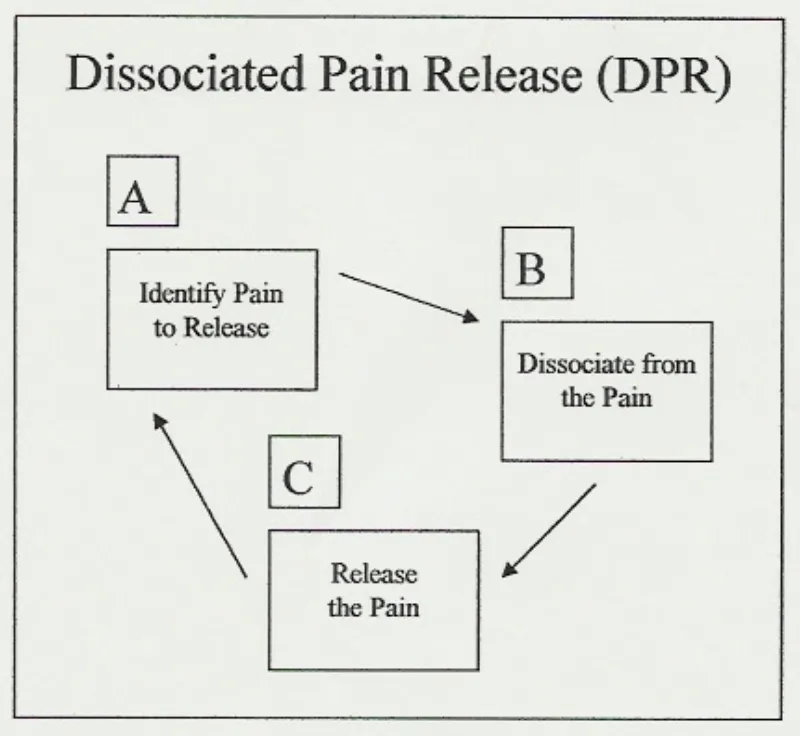
DPR has three cyclical steps: (A) identify pain to release, (B) dissociate from the pain, and (C) release the pain. Once understood, DPR is a simple, repetitive process that applies in many self-help situations. Any user employing DPR expects to complete its A-B-C cycle several times in any one self-help session. It is understood that there may be several painful emotions, different forms of physical pain and other negative bodily sensations that require release, making time and repetition necessary.
IMPORTANT
* DPR is not trauma therapy.
Anne is not a therapist and does not support individuals through trauma therapy. Anne teaches a self-help technique that individuals can apply to many situations in their everyday lives and that they have a right to use to manage any experiences they choose, traumatic or not. It is always recommended that trauma survivors hire a licensed trauma therapists whenever possible. Call 911 in any emergency.
Feeling Suicidal?
Find a Helpline

Anne MacMillan, MLA
Survivor, Consultant, Coach, Educator
Master's Clinical Psychology, Harvard Univerisity
IMPORTANT
* DPR is not trauma therapy.
Anne is not a therapist and does not support individuals through trauma therapy. Anne teaches a self-help technique that individuals can apply to many situations in their everyday lives and that they have a right to use to manage any experiences they choose, traumatic or not.
It is always recommended that trauma survivors hire a licensed trauma therapists whenever possible. Call 911 in any emergency.
Feeling Suicidal?
Find a Helpline:
https://findahelpline.com/
About Me
Like many others, I grew up in a household that didn't offer me the basic protections all children need. I experienced extreme trauma as a very young child and, unfortunately, that trauma continued into my adolescence and adulthood.
I survived adolescence emotionally by focusing on studying contemporary dance, helping me process my emotions and increase my body awareness. As a young adult in my twenties, I was exposed to relaxation and meditation techniques and the idea that healing that comes naturally when we move our eyes as we dream.
In my mid-twenties, memories of traumatic events that had happened during my early childhood began to return to my consciousness. I knew about EMDR (Eye-Movement Desensitization and Reprocessing) therapy for trauma, but wasn't in a situation that allowed me consistent access to a trauma therapist.
So, I began working through my traumatic memories on my own, combining what I'd learned about the emotions I felt in my body through dancing with relaxation and visualization techniques. I added what I decided to call REM Simulation -- or Rapid Eye Movement Simulation. REM sleep is the deep dreaming sleep in which humans naturally process emotions.
The result was a self-help technique that made it possible for me to work through the terrible emotions associated with traumatic events that had occurred in my past and regain the sense of emotional stability I needed -- all without having an opportunity to get the therapeutic support I needed.
Dissociated Pain Release
I dubbed my self-help technique DPR, or Dissociated Pain Release, and decided that I didn't want it to ever become something that anyone with an advanced degree and a lot of privilege could tell people they weren't qualified to perform at home on their own.
Therapy is wonderful and everyone who has access to a therapist should take advantage of that privilege. But recovery strategies should be available to anyone anywhere. That's what DPR is about for me.
From my perspective, DPR is nothing more than a collection of practical ideas put together in one package to help all of us get through the difficult emotions humans feel. It's valuable because it works and it uses human's natural REM (Rapid Eye Movement) sleep processing methods.

My Newest Blog Posts

Identity: The Fifth Task
Series IV, Article 1: Identity: The Fifth Task
Who am I, underneath all of this?
That is the question both the autistic and non-autistic arrive at after moving through the developmental stages the previous series have described. Not always consciously, not always in those words, but as a persistent uncertainty that keeps surfacing even when life is going reasonably well, a sense that something essential has not yet been settled.
The series on attachment traced how the self learns whether the world is safe enough to trust, and what it carries forward when that learning has been incomplete or distorted. The series on boundaries traced how the self discovers where it ends and another person begins, and what happens when the developmental conditions for that discovery were not adequately provided. Both of those developmental territories shape what a person brings to the fifth task, but neither of them is the fifth task.
The fifth task is identity, and it is the one this series is about.
What Identity Formation Actually Is
Erik Erikson placed identity formation as the fifth stage of psychosocial development, arriving after trust, autonomy, initiative, and industry have done their work (Erikson, 1968). He was precise about what the stage requires, and that precision matters more than the label. Identity formation is not simply self-knowledge. It is the achievement of a coherent sense of self that holds together across time and context, that can be recognized as continuously oneself despite the changes and roles and relationships that come and go (Erikson, 1968; McAdams, 2001; McAdams & McLean, 2013). Erikson called this quality self-sameness: the felt experience of being recognizably the same person in different settings and at different moments across the span of a developing life (Erikson, 1968).
That felt continuity is not automatic. It has to be built, and what it is built from is the accumulated material of the stages that preceded it. The person who arrives at identity formation with a stable experience of trust, a robust sense of their own will and its legitimacy, a history of initiative that was met with genuine response rather than correction, and a felt sense of competence built through accurate feedback is building on solid developmental ground. The person who arrives with shame and doubt in the Eriksonian sense, with a working model oriented toward wariness, with a self that has learned to defer rather than to act from itself, with a sense of inferiority built from years of being measured by standards they were not made to meet, is not building on the same ground (Erikson, 1968). Identity formation does not happen in a vacuum. It happens on the soil that everything before it prepared.
This is why the previous series matter for what this one is about. The developmental histories they traced are not background context. They are the conditions under which the fifth task is being attempted.
What the Task Actually Requires
What identity formation requires, beyond the developmental foundation it builds on, is a particular kind of feedback. Not simply positive feedback, and not approval. Something more specific: feedback accurate enough that the person can begin to distinguish the self they have been performing from the self that would emerge if the performance were no longer required (Erikson, 1968; Marcia, 1966; McAdams & McLean, 2013).
This is harder to get than it might sound. Most of the feedback people receive across the developmental journey is feedback about behavior: whether actions conform to norms, whether performance meets standards, whether expression fits what the environment is prepared to receive. That kind of feedback tells a person whether they are succeeding or failing by the environment's measure. It does not tell them who they actually are. Identity formation requires something the behavioral feedback loop rarely provides: honest information about who the person actually is, as distinct from how well they are performing the version of themselves the environment expects (Erikson, 1968; Marcia, 1966; McAdams, 2001).
For this reason, identity formation is always, at its core, a relational process. The self does not discover itself in isolation. It discovers itself in encounter with people and environments that can reflect it back with sufficient accuracy that it begins to cohere into something recognizable. Erikson understood this. The identity stage is not a solitary achievement. It is a social one, produced in the back-and-forth between the developing self and the worlds it moves through (Erikson, 1968; Pfeifer & Berkman, 2018; Ragelienė, 2016).
And this is precisely where neurology enters the picture in ways the existing developmental frameworks have not yet organized.
The Framework That Has Been Missing
MacMillan's Spiral and Staircase Model™ proposes that autistic and non-autistic developmental pathways differ not only in their rhythm and structure but in the fundamental mechanisms through which feedback from the social world arrives and is processed. Those differences shape every stage of the developmental journey. At the identity stage, they become particularly consequential, because the social mechanisms through which identity has traditionally been understood to form are, like attachment theory and boundary development before them, mechanisms that were built around the non-autistic nervous system as their invisible default (Erikson, 1968; Huang et al., 2017; Milton, 2012).
For people whose development follows the non-autistic pathway, identity forms significantly through a process that might be called outside-in. The self encounters social feedback continuously, integrating what it receives into an evolving picture of who it is and how it stands in the world, and over time develops a self-concept grounded in both external recognition and internal commitment (Erikson, 1968; Marcia, 1966; Pfeifer & Berkman, 2018). The social world is one of the primary instruments through which the non-autistic self becomes legible to itself. Seeing oneself reflected in the eyes of others, and gradually making sense of those reflections into something coherent, is a central mechanism of non-autistic identity formation, and it draws on the same body empathy, the same continuous, embodied, largely automatic reception of social information, that has characterized the non-autistic developmental pathway throughout (McAdams & McLean, 2013; Pfeifer & Berkman, 2018; Ragelienė, 2016).
For people whose development follows the autistic pathway, that instrument is not the primary one. The autistic pathway builds its understanding of the social world, and of itself within that world, more sequentially, more deliberately, and more dependently on explicit information rather than the real-time felt registration of how it is being received (Huang et al., 2017; Milton, 2012). The autistic self tends to build its self-concept more from the inside out: from its own internal experience of its values, capacities, and ways of engaging with the world, alongside the responses it receives from an environment that frequently misreads it (Botha & Frost, 2020; Huang et al., 2017; Milton, 2012). That inside-out construction is not a lesser way of forming an identity. It has genuine strengths, including a directness of relationship with one's own perspective and a capacity for self-knowledge that does not depend on continuous social calibration. But it faces different obstacles, and the most significant of those obstacles is this: the inside-out construction depends on having access to the authentic self from which the construction is being made (Coutelle et al., 2020; Huang et al., 2017).
For many autistic people, by the time identity formation reaches its most critical developmental period, that access has already been substantially compromised. The correction environments that shaped the autonomy, initiative, and industry stages taught the self that its natural expressions require adjustment before they will be welcome. Masking built a performed self over the authentic one, layer by layer, until the distance between them became genuinely difficult to cross (Perry et al., 2022). The self that is now trying to build a coherent identity is often trying to build it from materials it can no longer fully locate, which is one of the reasons the question underneath everything, who am I, can feel so persistent and so hard to answer (Allé et al., 2025; Corden et al., 2021; Coutelle et al., 2020; Davies et al., 2024).
In MacMillan's theoretical framework, the high body empathetic faces the identity task from a different structural position but arrives at a similarly disorienting place. The outside-in process that characterizes the non-autistic developmental pathway operates, for the high body empathetic, with unusual force. The nervous system is oriented continuously toward others' experience with an intensity that makes the distinction between one's own inner life and the perspectives of the people around them genuinely difficult to maintain. Over time, and particularly in close relationship with an autistic partner whose perspective tends to fill more and more of the relational space, the social world may be reflecting back an image shaped increasingly by someone else's perspective rather than their own. The question who am I arises not from an absence of social feedback but from having been, in some fundamental sense, more responsive to others' worlds than to one's own.
Both people are asking the same question. They are asking it from genuinely different positions, through genuinely different developmental histories, with genuinely different obstacles between where they are and where they need to get to. Neither the developmental psychology literature on identity formation nor the autism literature on autistic identity has yet given a full account of what those different positions mean for how the fifth task is approached and what it actually requires (Davies et al., 2024; Erikson, 1968; Huang et al., 2017; Milton, 2012).
That is the gap this series is attempting to fill.
Two Paths Toward the Same Self
The articles that follow will trace identity formation across both pathways, examining what each requires and where each is most vulnerable to disruption. They will look at what happens when the mirror that identity formation depends on finally arrives, whether through an autism diagnosis in adulthood or through encounter with a community of people whose neurology matches one's own (Botha et al., 2022; Cooper et al., 2023; Corden et al., 2021). They will examine what identity formation looks like inside neurodiverse relationships, where both people are navigating the task in environments that consistently provide less of what each pathway needs than optimal development would have offered (Milton, 2012). And they will describe what genuine identity formation looks like when it goes well: not the absence of a difficult developmental history, but the achievement of a self that knows who it is, that can be recognized as itself across time and context, and that can bring itself genuinely into relationship with the world without having to disappear in the process (Erikson, 1968; Marcia, 1966; McAdams & McLean, 2013).
The destination is the same for everyone. The routes are different, the obstacles are different, and the conditions that would have supported the journey are different. But the question is the same, and the series that follows is an attempt to take it seriously for both neurotypes at once, which the existing frameworks have not yet done.
Who am I?
That is where we begin.
Next in this series: The Oscillation That Rises: Identity Formation in Non-Autistic Development, how identity forms along the non-autistic developmental pathway through the continuous oscillation of confidence and self-doubt, what keeps that oscillation going, and what happens when the accommodative half of the cycle runs more strongly than the assimilative one.
THE SERIES
Article 1: Identity — The Fifth Task
Article 2: The Oscillation that Rises — Identity Formation in Non-Autistic Development
Article 3: The Staircase that Rises — Identity Formation in Autistic Development
Article 4: When the Self is Finally Named
Article 5: Neurodiverse Relationships — Two Selves, One Room
Article 6: The Self that Knows Where it Stands
References
Allé, M. C., Schneider, P., Rigoulot, L., Gandolphe, M.-C., Danion, J.-M., Coutelle, R., & Berna, F. (2025). Narrative identity differences in autism. Scientific Reports, 15, Article 16990. https://doi.org/10.1038/s41598-025-00178-0
Botha, M., Dibb, B., & Frost, D. M. (2022). “It’s being a part of a grand tradition, a grand counter-culture which involves communities”: A qualitative investigation of autistic community connectedness. Autism, 26(8), 2151–2164. https://doi.org/10.1177/13623613221080248
Botha, M., & Frost, D. M. (2020). Extending the minority stress model to understand mental health problems experienced by the autistic population. Society and Mental Health, 10(1), 20–34. https://doi.org/10.1177/2156869318804297
Cooper, K., Russell, A. J., Lei, J., & Smith, L. G. E. (2023). The impact of a positive autism identity and autistic community solidarity on social anxiety and mental health in autistic young people. Autism, 27(3), 848–857. https://doi.org/10.1177/13623613221118351
Corden, K., Brewer, R., & Cage, E. (2021). Personal identity after an autism diagnosis: Relationships with self-esteem, mental wellbeing, and diagnostic timing. Frontiers in Psychology, 12, Article 699335. https://doi.org/10.3389/fpsyg.2021.699335
Coutelle, R., Goltzene, M.-A., Bizet, E., Schoenberger, M., Berna, F., & Danion, J.-M. (2020). Self-concept clarity and autobiographical memory functions in adults with autism spectrum disorder without intellectual deficiency. Journal of Autism and Developmental Disorders, 50, 3874–3882. https://doi.org/10.1007/s10803-020-04447-x
Davies, J., Cooper, K., Killick, E., Sam, E., Healy, M., Thompson, G., Mandy, W., Redmayne, B., & Crane, L. (2024). Autistic identity: A systematic review of quantitative research. Autism Research, 17(5), 874–897. https://doi.org/10.1002/aur.3105
Erikson, E. H. (1968). Identity: Youth and crisis. W. W. Norton.
Huang, A. X., Hughes, T. L., Sutton, L. R., Lawrence, M., Chen, X., Ji, Z., & Zeleke, W. (2017). Understanding the self in individuals with autism spectrum disorder: A review of literature. Frontiers in Psychology, 8, Article 1422. https://doi.org/10.3389/fpsyg.2017.01422
Marcia, J. E. (1966). Development and validation of ego-identity status. Journal of Personality and Social Psychology, 3(5), 551–558. https://doi.org/10.1037/h0023281
McAdams, D. P. (2001). The psychology of life stories. Review of General Psychology, 5(2), 100–122. https://doi.org/10.1037/1089-2680.5.2.100
McAdams, D. P., & McLean, K. C. (2013). Narrative identity. Current Directions in Psychological Science, 22(3), 233–238. https://doi.org/10.1177/0963721413475622
Milton, D. E. M. (2012). On the ontological status of autism: The “double empathy problem.” Disability & Society, 27(6), 883–887. https://doi.org/10.1080/09687599.2012.710008
Perry, E., Mandy, W., Hull, L., & Cage, E. (2022). Understanding camouflaging as a response to autism-related stigma: A social identity theory approach. Journal of Autism and Developmental Disorders, 52, 800–810. https://doi.org/10.1007/s10803-021-04987-w
Pfeifer, J. H., & Berkman, E. T. (2018). The development of self and identity in adolescence: Neural evidence and implications for a value-based choice perspective on motivated behavior. Child Development Perspectives, 12(3), 158–164. https://doi.org/10.1111/cdep.12279
Ragelienė, T. (2016). Links of adolescents identity development and relationship with peers: A systematic literature review. Journal of the Canadian Academy of Child and Adolescent Psychiatry, 25(2), 97–105.

© 2023 REAL Neurodiverse
All Rights Reserved
anne@neurodiversemarriage.com
Text or Call: (617) 996-7239 (United States)