DPR
Dissociated Pain Release
A self-help technique developed by a trauma survivor

Anne MacMillan, MLA
Survivor, Consultant, Coach
Master's Clinical Psychology - Harvard University
Dissociated Pain Release
Self-Help Trauma Support
Dissociated Pain Release
Dissociated Pain Release (DPR) is a self-help technique that allows users to release emotional pain from trauma without re-experiencing it. It is based on the idea that emotional pain is stored in the mind, body, and nervous system and that the stored pain causes distress and discomfort in the present, whether the trauma was a recent event or something that happened many years ago.
There is no need for a DPR user to know where any emotional pain came from. All a user needs to know is that they are currently experiencing unwanted emotional pain and that they would like to release that pain and feel better -- quickly.
Most importantly, in DPR, emotional pains are released while the user is dissociated from them -- allowing the user to process any trauma or distress without being forced to relive the original traumatic experience.
Examples of emotional pain that can be released from the body and nervous system through DPR include rage, anger, shame, sadness, guilt, grief, loneliness, abandonment, anxiety, and fear.
Likewise, DRP allows users to release any stored sensations associated with physical pain or forms of bodily discomfort that happened in the past. DPR users can release sensations of nausea, dizziness, cold, being drugged, etc. Again, all these sensations are released without the DRP user re-experiencing the original potency of any traumatic event. Often DPR users release pain without even knowing what the original traumatic event may have been.
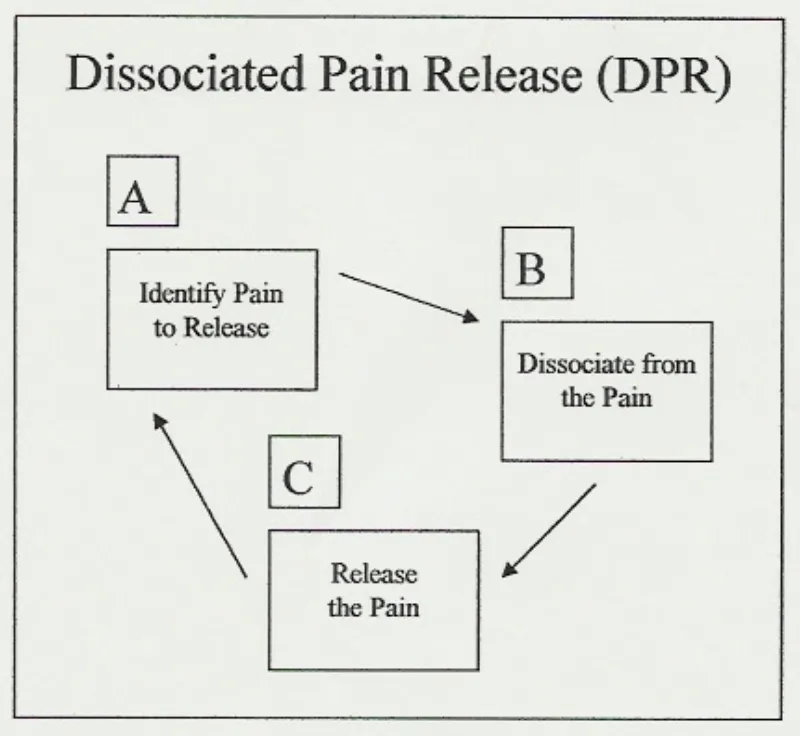
DPR has three cyclical steps: (A) identify pain to release, (B) dissociate from the pain, and (C) release the pain. Once understood, DPR is a simple, repetitive process that applies in many self-help situations. Any user employing DPR expects to complete its A-B-C cycle several times in any one self-help session. It is understood that there may be several painful emotions, different forms of physical pain and other negative bodily sensations that require release, making time and repetition necessary.
IMPORTANT
* DPR is not trauma therapy.
Anne is not a therapist and does not support individuals through trauma therapy. Anne teaches a self-help technique that individuals can apply to many situations in their everyday lives and that they have a right to use to manage any experiences they choose, traumatic or not. It is always recommended that trauma survivors hire a licensed trauma therapists whenever possible. Call 911 in any emergency.
Feeling Suicidal?
Find a Helpline

Anne MacMillan, MLA
Survivor, Consultant, Coach, Educator
Master's Clinical Psychology, Harvard Univerisity
IMPORTANT
* DPR is not trauma therapy.
Anne is not a therapist and does not support individuals through trauma therapy. Anne teaches a self-help technique that individuals can apply to many situations in their everyday lives and that they have a right to use to manage any experiences they choose, traumatic or not.
It is always recommended that trauma survivors hire a licensed trauma therapists whenever possible. Call 911 in any emergency.
Feeling Suicidal?
Find a Helpline:
https://findahelpline.com/
About Me
Like many others, I grew up in a household that didn't offer me the basic protections all children need. I experienced extreme trauma as a very young child and, unfortunately, that trauma continued into my adolescence and adulthood.
I survived adolescence emotionally by focusing on studying contemporary dance, helping me process my emotions and increase my body awareness. As a young adult in my twenties, I was exposed to relaxation and meditation techniques and the idea that healing that comes naturally when we move our eyes as we dream.
In my mid-twenties, memories of traumatic events that had happened during my early childhood began to return to my consciousness. I knew about EMDR (Eye-Movement Desensitization and Reprocessing) therapy for trauma, but wasn't in a situation that allowed me consistent access to a trauma therapist.
So, I began working through my traumatic memories on my own, combining what I'd learned about the emotions I felt in my body through dancing with relaxation and visualization techniques. I added what I decided to call REM Simulation -- or Rapid Eye Movement Simulation. REM sleep is the deep dreaming sleep in which humans naturally process emotions.
The result was a self-help technique that made it possible for me to work through the terrible emotions associated with traumatic events that had occurred in my past and regain the sense of emotional stability I needed -- all without having an opportunity to get the therapeutic support I needed.
Dissociated Pain Release
I dubbed my self-help technique DPR, or Dissociated Pain Release, and decided that I didn't want it to ever become something that anyone with an advanced degree and a lot of privilege could tell people they weren't qualified to perform at home on their own.
Therapy is wonderful and everyone who has access to a therapist should take advantage of that privilege. But recovery strategies should be available to anyone anywhere. That's what DPR is about for me.
From my perspective, DPR is nothing more than a collection of practical ideas put together in one package to help all of us get through the difficult emotions humans feel. It's valuable because it works and it uses human's natural REM (Rapid Eye Movement) sleep processing methods.

My Newest Blog Posts

When the Self is Finally Named
Series IV, Article 4: When the Self Is Finally Named
There is a particular quality to the moment when an autistic person first encounters language that fits them. Whether it arrives through a formal diagnostic process, through reading something that describes an experience they have always had but never been able to name, or through a conversation with another autistic person who describes the world in terms that feel immediately and uncannily accurate, the experience tends to carry a distinctive character: the simultaneous sensation of something clarifying and something collapsing (Corden et al., 2021; Gellini & Marczak, 2024; Kiehl et al., 2024). What was inexplicable is suddenly explicable. And alongside the relief of that, often arriving in the same moment, is something harder: the accumulated weight of everything that might have been different if this understanding had come sooner (Bransgrove & Karakas, 2025; Corden et al., 2021; Gellini & Marczak, 2024).
That combination, relief and grief arriving together, is one of the most consistent features of the identification experience that autistic people describe (Gellini & Marczak, 2024; Kiehl et al., 2024). It is not a pathological response. It is a developmentally appropriate one. And understanding why requires understanding what identification actually does, not only emotionally but developmentally, for the inside-out construction of identity that the previous post described.
What Identification Does
The inside-out construction of identity depends, as the previous post established, on having access to the authentic self from which the construction is being made. Years of correction environments, distorted feedback, and the accumulated layers of masking have, for many autistic people, made that access genuinely difficult. The self has been building from whatever materials were available, often from the performed self rather than the authentic one, often from distorted feedback rather than accurate information, and the self-concept that formed from those materials carries the character of something built on uncertain ground (Corden et al., 2021; Gellini & Marczak, 2024; Kiehl et al., 2024).
Identification changes the raw material available for the construction. When the autistic person encounters accurate language for their experience, whether through formal diagnosis, through self-recognition, or through the recognition offered by another autistic person, something shifts in the inside-out process. The accommodation phase of the developmental staircase receives new and accurate information: this is who you actually are, this is why the world has felt the way it has felt, this is the framework within which your experience makes sense. That is a genuine vertical rise. The self-concept is reorganizing around something real rather than around distorted feedback or the performed self (Corden et al., 2021; Gellini & Marczak, 2024; Kiehl et al., 2024).
The retrospective re-evaluation that typically follows identification is the inside-out construction doing what it was always trying to do: building from accurate material. The autistic person revisiting their past through the new lens of autistic understanding is not simply reinterpreting memory (Bransgrove & Karakas, 2025; Corden et al., 2021; Kiehl et al., 2024). And for many autistic people, that revisiting works as much through pattern recognition as through narrative reconstruction. The recurring experiences that never quite made sense, the reliable gaps between intention and reception, the consistent mismatches that seemed to follow them from one context to the next, suddenly resolve into a recognizable structure. This is what was happening. This is why it kept happening in precisely this way. That recognition of underlying pattern is not less coherent than a narrative connecting events through cause and effect. For a pathway organized around systematic observation and the identification of structure, it may be the more natural form through which the self achieves its continuity across time: not a story so much as a recognized shape, present all along and finally visible (Allé et al., 2025; McAdams, 2001; McAdams & McLean, 2013).
The Complexity of the Process
That this process is experienced as complex, often simultaneously liberating and disorienting, makes developmental sense. Using the framework Marcia developed from Erikson's work, what identification typically initiates is a moratorium: a period of active exploration in which previous commitments to identity are being examined and revised, and new ones have not yet been made (Erikson, 1968; Marcia, 1966). The autistic person who has been living inside a foreclosed identity, committed to the performed self without having genuinely examined who is underneath it, or inside a diffuse identity, unable to locate any stable self-concept at all, now has access to the kind of genuine exploration that identity achievement requires (Marcia, 1966). Moratorium is not a crisis. It is a developmental phase, and it is the necessary predecessor to genuine identity achievement (Erikson, 1968; Marcia, 1966).
But moratorium is also uncomfortable, and it is worth naming why. The grief that often accompanies identification is not only grief for the past, though it is that. It is also the specific discomfort of being between two self-concepts: the one that was built on the available material, however distorted, and the one that is now being built on more accurate ground but is not yet complete (Bransgrove & Karakas, 2025; Corden et al., 2021; Gellini & Marczak, 2024). The performed self that masking constructed may have been costly, but it was at least legible, at least known. The authentic self becoming available through identification may feel, in the early stages, simultaneously more true and less certain, because it is genuinely new territory.
Research consistently finds that the process following identification is emotionally complex, carrying relief, grief, and disorientation alongside each other, and that time and support are what allow it to move toward the integration and acceptance that positive autistic identity represents (Bransgrove & Karakas, 2025; Corden et al., 2021; Gellini & Marczak, 2024; Kiehl et al., 2024). Neither the relief nor the grief should be rushed. Both are part of the developmental work that identification initiates.
Community as the Holding Environment
Here is where autistic community becomes not simply a social resource but a genuine developmental one. What the moratorium requires, in order to move toward achievement rather than stalling in ongoing exploration, is a holding environment: in Kegan's terms, a context that simultaneously confirms the person where they are and challenges them toward where they are going (Kegan, 1982; Marcia, 1966).
For the autistic person in the moratorium that identification initiates, what that holding environment looks like is specific. It needs to receive the authentic self accurately: to recognize autistic ways of communicating, perceiving, and engaging as legitimate and intelligible rather than as deviations to be corrected. It needs to offer the kind of neurotype-matched interaction that research has documented makes a genuine difference: the same-neurotype ease in which information transfers effectively, rapport forms readily, and the experience of being genuinely understood is available without the sustained effort that cross-neurotype interaction typically requires (Crompton, Hallett, et al., 2020; Crompton, Sharp, et al., 2020; Milton, 2012). And it needs to hold both the confirmation and the challenge: affirming the autistic identity while also expecting genuine growth, rather than treating identification as either a problem to be managed or a fixed endpoint to be celebrated (Botha et al., 2022; Kegan, 1982; Marcia, 1966).
This is what autistic community, at its best, provides. The encounter with other autistic people whose ways of being in the world feel familiar is not simply pleasurable. It is developmentally significant (Botha et al., 2022; Crompton, Hallett, et al., 2020). It provides the horizontal surface that follows the vertical rise of identification: the space in which the new self-understanding can be applied, tested, and consolidated. The autistic person learning, through sustained contact with other autistic people, that their particular way of engaging is legible, that their enthusiasms are met with recognition rather than management, that their ways of communicating land without requiring translation, is assimilating the new self-concept into their lived experience of the world. The inside-out construction is finally proceeding on solid ground (Botha et al., 2022; Crompton, Hallett, et al., 2020; Crompton, Sharp, et al., 2020).
Research supports what autistic people have known from experience: autistic community connectedness buffers the effects of minority stress on mental health, and positive autistic identity is strongly and consistently linked to reduced anxiety, better mental health, and higher self-esteem (Botha & Frost, 2020; Botha et al., 2022; Cooper et al., 2023; Corden et al., 2021). This is not a correlation of sentiment. It is a description of what happens when the inside-out construction of identity finally has what it needed: accurate recognition, neurotype-calibrated feedback, and a holding environment that can receive the authentic self rather than requiring the performed one (Botha et al., 2022; Cooper et al., 2023; Crompton, Hallett, et al., 2020).
What Positive Autistic Identity Actually Requires
Positive autistic identity is not simply the feeling of being comfortable with being autistic. It is an achievement in the developmental sense: a self-concept that has been genuinely explored, that integrates autistic experience as a real and valued part of who the person is, and that is stable enough to provide the felt continuity across time and context that Erikson called self-sameness (Cooper et al., 2023; Erikson, 1968; Marcia, 1966).
What the research makes clear is that this achievement is not primarily an internal one. It does not come from deciding to feel differently. It comes from the quality of the environment: from the experience of being accepted, understood, and genuinely received rather than corrected, managed, or required to perform a different version of the self (Botha et al., 2022; Cooper et al., 2023; Crompton, Hallett, et al., 2020). External acceptance and support are better predictors of positive autistic identity than individual-level factors (Cooper et al., 2023). The environment is doing the developmental work that the environment always does. When it finally provides what was always needed, the staircase can rise.
That rise is not the end of the identity journey. Identification and community create the conditions for identity formation to proceed; they do not complete it. The question who am I still requires the ongoing work of exploration and commitment, the integration of autistic identity with all the other dimensions of who the person is: their relationships, their work, their values, their history, their ways of contributing to the world beyond themselves (Erikson, 1968; Marcia, 1966; McAdams, 2001; McAdams & McLean, 2013). Erikson's sixth stage is waiting. Generativity and integrity are further down the path. The destination has not changed. What has changed is the ground on which the journey forward is now being taken, and for the first time, it is solid (Erikson, 1968).
Next in this series: Two Selves, One Room, what identity formation looks like inside neurodiverse relationships, how each person's developmental history shapes what they bring to the shared space, and what both people need in order to continue growing rather than interrupting each other's growth.
THE SERIES
Article 1: Identity — The Fifth Task
Article 2: The Oscillation that Rises — Identity Formation in Non-Autistic Development
Article 3: The Staircase that Rises — Identity Formation in Autistic Development
Article 4: When the Self is Finally Named
Article 5: Neurodiverse Relationships — Two Selves, One Room
Article 6: The Self that Knows Where it Stands
References
Allé, M. C., Schneider, P., Rigoulot, L., Gandolphe, M.-C., Danion, J.-M., Coutelle, R., & Berna, F. (2025). Narrative identity differences in autism. Scientific Reports, 15, Article 16990. https://doi.org/10.1038/s41598-025-00178-0
Botha, M., Dibb, B., & Frost, D. M. (2022). “It’s being a part of a grand tradition, a grand counter-culture which involves communities”: A qualitative investigation of autistic community connectedness. Autism, 26(8), 2151–2164. https://doi.org/10.1177/13623613221080248
Botha, M., & Frost, D. M. (2020). Extending the minority stress model to understand mental health problems experienced by the autistic population. Society and Mental Health, 10(1), 20–34. https://doi.org/10.1177/2156869318804297
Bransgrove, K., & Karakas, G. (2025). “Being autistic is kind of who you are, it’s an identity rather than a disorder”: Identity negotiation and construction among autistic adults diagnosed in later life. Journal of Autism and Developmental Disorders. Advance online publication. https://doi.org/10.1007/s10803-025-06865-1
Cooper, K., Russell, A. J., Lei, J., & Smith, L. G. E. (2023). The impact of a positive autism identity and autistic community solidarity on social anxiety and mental health in autistic young people. Autism, 27(3), 848–857. https://doi.org/10.1177/13623613221118351
Corden, K., Brewer, R., & Cage, E. (2021). Personal identity after an autism diagnosis: Relationships with self-esteem, mental wellbeing, and diagnostic timing. Frontiers in Psychology, 12, Article 699335. https://doi.org/10.3389/fpsyg.2021.699335
Crompton, C. J., Hallett, S., Ropar, D., Flynn, E. G., & Fletcher-Watson, S. (2020). “I never realised everybody felt as happy as I do when I am around autistic people”: A thematic analysis of autistic adults’ relationships with autistic and neurotypical friends and family. Autism, 24(6), 1438–1448. https://doi.org/10.1177/1362361320908976
Crompton, C. J., Ropar, D., Evans-Williams, C. V. M., Flynn, E. G., & Fletcher-Watson, S. (2020). Autistic peer-to-peer information transfer is highly effective. Autism, 24(7), 1704–1712. https://doi.org/10.1177/1362361320919286
Crompton, C. J., Sharp, M., Axbey, H., Fletcher-Watson, S., Flynn, E. G., & Ropar, D. (2020). Neurotype-matching, but not being autistic, influences self and observer ratings of interpersonal rapport. Frontiers in Psychology, 11, Article 586171. https://doi.org/10.3389/fpsyg.2020.586171
Erikson, E. H. (1968). Identity: Youth and crisis. W. W. Norton.
Gellini, H., & Marczak, M. (2024). “I always knew I was different”: Experiences of receiving a diagnosis of autistic spectrum disorder in adulthood—a meta-ethnographic systematic review. Review Journal of Autism and Developmental Disorders, 11(3), 620–639. https://doi.org/10.1007/s40489-023-00356-8
Kegan, R. (1982). The evolving self: Problem and process in human development. Harvard University Press.
Kiehl, I., Pease, R., & Hackmann, C. (2024). The adult experience of being diagnosed with autism spectrum disorder: A qualitative meta-synthesis. Autism, 28(5), 1060–1074. https://doi.org/10.1177/13623613231220419
Marcia, J. E. (1966). Development and validation of ego-identity status. Journal of Personality and Social Psychology, 3(5), 551–558. https://doi.org/10.1037/h0023281
McAdams, D. P. (2001). The psychology of life stories. Review of General Psychology, 5(2), 100–122. https://doi.org/10.1037/1089-2680.5.2.100
McAdams, D. P., & McLean, K. C. (2013). Narrative identity. Current Directions in Psychological Science, 22(3), 233–238. https://doi.org/10.1177/0963721413475622
Milton, D. E. M. (2012). On the ontological status of autism: The “double empathy problem.” Disability & Society, 27(6), 883–887. https://doi.org/10.1080/09687599.2012.710008

© 2023 REAL Neurodiverse
All Rights Reserved
anne@neurodiversemarriage.com
Text or Call: (617) 996-7239 (United States)