DPR
Dissociated Pain Release
A self-help technique developed by a trauma survivor

Anne MacMillan, MLA
Survivor, Consultant, Coach
Master's Clinical Psychology - Harvard University
Dissociated Pain Release
Self-Help Trauma Support
Dissociated Pain Release
Dissociated Pain Release (DPR) is a self-help technique that allows users to release emotional pain from trauma without re-experiencing it. It is based on the idea that emotional pain is stored in the mind, body, and nervous system and that the stored pain causes distress and discomfort in the present, whether the trauma was a recent event or something that happened many years ago.
There is no need for a DPR user to know where any emotional pain came from. All a user needs to know is that they are currently experiencing unwanted emotional pain and that they would like to release that pain and feel better -- quickly.
Most importantly, in DPR, emotional pains are released while the user is dissociated from them -- allowing the user to process any trauma or distress without being forced to relive the original traumatic experience.
Examples of emotional pain that can be released from the body and nervous system through DPR include rage, anger, shame, sadness, guilt, grief, loneliness, abandonment, anxiety, and fear.
Likewise, DRP allows users to release any stored sensations associated with physical pain or forms of bodily discomfort that happened in the past. DPR users can release sensations of nausea, dizziness, cold, being drugged, etc. Again, all these sensations are released without the DRP user re-experiencing the original potency of any traumatic event. Often DPR users release pain without even knowing what the original traumatic event may have been.
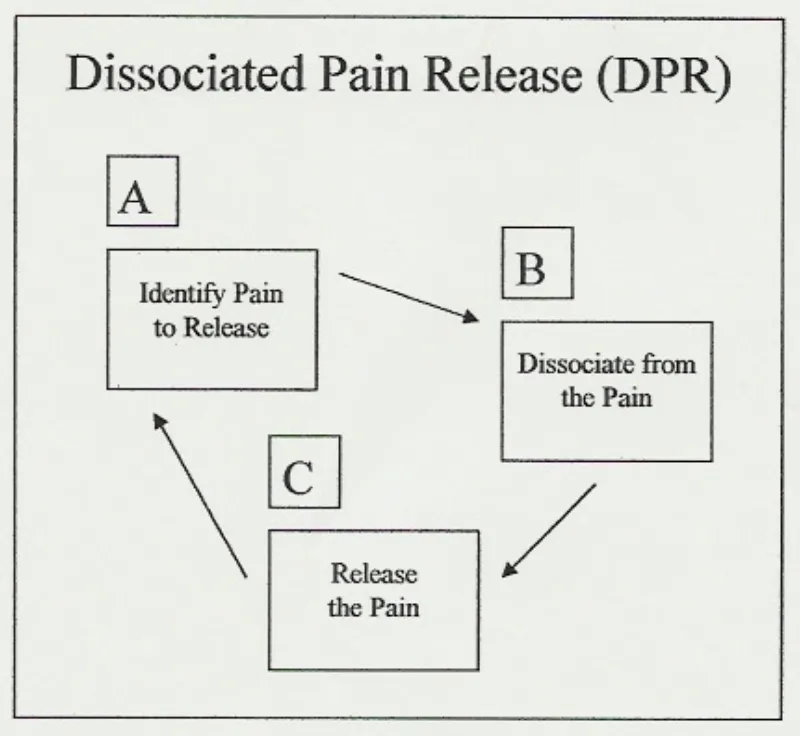
DPR has three cyclical steps: (A) identify pain to release, (B) dissociate from the pain, and (C) release the pain. Once understood, DPR is a simple, repetitive process that applies in many self-help situations. Any user employing DPR expects to complete its A-B-C cycle several times in any one self-help session. It is understood that there may be several painful emotions, different forms of physical pain and other negative bodily sensations that require release, making time and repetition necessary.
IMPORTANT
* DPR is not trauma therapy.
Anne is not a therapist and does not support individuals through trauma therapy. Anne teaches a self-help technique that individuals can apply to many situations in their everyday lives and that they have a right to use to manage any experiences they choose, traumatic or not. It is always recommended that trauma survivors hire a licensed trauma therapists whenever possible. Call 911 in any emergency.
Feeling Suicidal?
Find a Helpline

Anne MacMillan, MLA
Survivor, Consultant, Coach, Educator
Master's Clinical Psychology, Harvard Univerisity
IMPORTANT
* DPR is not trauma therapy.
Anne is not a therapist and does not support individuals through trauma therapy. Anne teaches a self-help technique that individuals can apply to many situations in their everyday lives and that they have a right to use to manage any experiences they choose, traumatic or not.
It is always recommended that trauma survivors hire a licensed trauma therapists whenever possible. Call 911 in any emergency.
Feeling Suicidal?
Find a Helpline:
https://findahelpline.com/
About Me
Like many others, I grew up in a household that didn't offer me the basic protections all children need. I experienced extreme trauma as a very young child and, unfortunately, that trauma continued into my adolescence and adulthood.
I survived adolescence emotionally by focusing on studying contemporary dance, helping me process my emotions and increase my body awareness. As a young adult in my twenties, I was exposed to relaxation and meditation techniques and the idea that healing that comes naturally when we move our eyes as we dream.
In my mid-twenties, memories of traumatic events that had happened during my early childhood began to return to my consciousness. I knew about EMDR (Eye-Movement Desensitization and Reprocessing) therapy for trauma, but wasn't in a situation that allowed me consistent access to a trauma therapist.
So, I began working through my traumatic memories on my own, combining what I'd learned about the emotions I felt in my body through dancing with relaxation and visualization techniques. I added what I decided to call REM Simulation -- or Rapid Eye Movement Simulation. REM sleep is the deep dreaming sleep in which humans naturally process emotions.
The result was a self-help technique that made it possible for me to work through the terrible emotions associated with traumatic events that had occurred in my past and regain the sense of emotional stability I needed -- all without having an opportunity to get the therapeutic support I needed.
Dissociated Pain Release
I dubbed my self-help technique DPR, or Dissociated Pain Release, and decided that I didn't want it to ever become something that anyone with an advanced degree and a lot of privilege could tell people they weren't qualified to perform at home on their own.
Therapy is wonderful and everyone who has access to a therapist should take advantage of that privilege. But recovery strategies should be available to anyone anywhere. That's what DPR is about for me.
From my perspective, DPR is nothing more than a collection of practical ideas put together in one package to help all of us get through the difficult emotions humans feel. It's valuable because it works and it uses human's natural REM (Rapid Eye Movement) sleep processing methods.

My Newest Blog Posts

What Intimacy Actually Is
Series V, Article 1: What Intimacy Actually Is
Identity, as the previous series established, is the developmental foundation from which everything that follows becomes possible. The self that knows where it stands can now do something it could not do before: bring itself into genuine contact with another person. Not proximity, not cohabitation, not even affection, though it may include all of those. Genuine contact: the experience of being known by another person as the self one actually is, and of knowing another in return (Erikson, 1968; Kegan, 1982; Laurenceau et al., 1998; Reis & Shaver, 1988).
That is what this series is about. Not closeness in the abstract, not the question of whether autistic or non-autistic people are capable of intimate relationships, not a catalog of relational difficulties. It is about intimacy as a specific developmental achievement with specific requirements and specific vulnerabilities, and about how those requirements and vulnerabilities look different across the autistic and non-autistic developmental pathways.
What Erikson Named
Erik Erikson placed intimacy as the sixth stage of psychosocial development, arriving after identity has done its foundational work (Erikson, 1968). The stage presents a central developmental challenge: the capacity to open the self genuinely to another person, to risk vulnerability, to allow the self to be known without the knowing destabilizing the self-concept that identity achieved. When that challenge is met, what becomes available is something the previous stages could not fully produce: the capacity for genuine, sustained mutual closeness, for commitment to another person and to the relationship itself, maintained through difficulty and change without requiring the self to dissolve in order to manage the proximity (Erikson, 1968; Kegan, 1982).
When the challenge is not met, the developmental outcome is isolation (Erikson, 1968). Not necessarily aloneness, and not necessarily unhappiness. Isolation in Erikson's sense is something more specific: the inability to allow genuine closeness, the self protecting its uncertain ground by preventing real encounter with another, relationships that remain shallow or performative or conditional on a distance that is never quite closed. Isolation can look, from the outside, like independence. From the inside, it tends to feel like a loneliness that does not resolve itself through any amount of activity or company.
The distinction between intimacy and isolation is not about how many people are in one's life. It is about whether any of them genuinely knows the self that is there to be known (Erikson, 1968; Laurenceau et al., 1998; Reis & Shaver, 1988).
What Intimacy Is and What It Is Not
The research on intimacy as an interpersonal process, built substantially through the work of Reis and Shaver and extended by Laurenceau and colleagues, establishes intimacy as a sequence: one person reveals something genuine about themselves; the other receives it in a way that communicates understanding, care, and real attention to what was shared; and the first person feels, in that reception, something of being genuinely known (Laurenceau et al., 1998; Reis & Shaver, 1988).
That is the mechanism. And the mechanism matters because it reveals something important: intimacy is not a state. It is a process. It is not achieved once and then maintained. It is built, and rebuilt, and built again, through an ongoing accumulation of genuine encounters in which the self is revealed and received (Laurenceau et al., 1998; Reis & Shaver, 1988). It deepens over time when the revealing and receiving happen repeatedly, when the self that is disclosed gradually becomes more complete and more honest, and when the reception that follows remains genuine (Altman & Taylor, 1973; Laurenceau et al., 1998).
What intimacy is not is equally important. Intimacy is not proximity: two people can share a home, a bed, a family, and a life without ever quite knowing each other in the sense this series is describing. Intimacy is not affection: warmth, care, and love in the ordinary sense can exist alongside a genuine absence of mutual knowing. And intimacy is not merger: the experience of feeling absorbed by another person, of losing the sense of the self in the presence of someone else, is not intimacy. It is the loss of the very condition that makes intimacy possible (Erikson, 1968; Kegan, 1982).
Genuine intimacy requires two selves. Not one self and a projection. Not one self and a reflection. Two distinct, differentiated, recognizably separate people who come into genuine contact with each other across the space that their distinctness creates. The contact is real only because the space is real. The knowing is possible only because there are two genuinely different inner worlds to be known (Erikson, 1968; Kegan, 1982; Laurenceau et al., 1998).
Why Identity Has to Come First
The previous series on identity ended with this: the question ahead is no longer who am I, but who are we, and what can we build together. That framing was deliberate, because the sequence is developmentally real. Intimacy requires identity in a way that runs deeper than Erikson's stage-ordering might suggest (Erikson, 1968).
To be genuinely known by another person, the self has to be available to be known. A self that does not yet know who it is cannot bring a coherent and authentic self-concept into genuine contact with another, because there is nothing stable enough to make contact with (Erikson, 1968; McAdams, 2001; McAdams & McLean, 2013). What tends to happen instead is one of two things. Either the self reaches toward the other and finds, in the closeness, a way to fill in what it does not yet know about itself from the other person's presence: merger, the self taking shape in the borrowed light of another identity. Or the self protects its uncertain ground by preventing genuine encounter: isolation, the self keeping others at a distance that feels like safety but functions like deprivation (Erikson, 1968; Kegan, 1982).
Both of these outcomes are recognizable in the developmental histories this series has traced. The autistic person who arrived at adult relationships with a self-concept built partly from distorted feedback or from the performed self that masking constructed may find that genuine closeness destabilizes what has been so effortfully built. The non-autistic person, and particularly the high body empathetic in MacMillan's theoretical framework, whose oscillation has been tilting toward accommodation, may find that closeness tips toward merger before it reaches the genuine contact that intimacy requires. Both of these are identity challenges appearing in the domain of intimacy. They are not addressed by working on the relationship in isolation. They are addressed by returning to the developmental foundation (Erikson, 1968; Kegan, 1982; McAdams & McLean, 2013).
This is why the identity series had to come before this one. Not because identity resolves everything, but because without it, the work of genuine intimacy cannot properly begin.
When Intimacy Fails
Merger and isolation are worth sitting with separately, because they look very different from the outside while reflecting the same underlying developmental gap.
Merger is the intimacy failure that most resembles intimacy from a distance. Two people are close, intensely involved with each other, and often deeply attached. But the closeness has come at the cost of the distinction that genuine intimacy requires. One self, or both, has organized itself around the other's presence, perspective, needs, and reactions in a way that makes genuine encounter between two distinct people structurally unavailable. There is closeness without genuine knowing, because the self that would be known has become difficult to locate within the relationship. Merger is the failure of the self's own ground (Erikson, 1968; Kegan, 1982).
Isolation is the failure of contact. The self knows where it stands and guards that ground carefully, but the guarding prevents the vulnerability that genuine intimacy requires. The self is available to be known in theory but not in practice, because the risk of revelation, of showing the actual self to another person and finding it unwelcome, is too significant to take. Isolation tends to accumulate a particular kind of loneliness: the loneliness of someone who is never quite reached, who meets many people and is genuinely known by none, who lives alongside others without ever fully arriving in the space between (Erikson, 1968; Laurenceau et al., 1998; Reis & Shaver, 1988).
Both carry costs that accumulate across adulthood in ways that Erikson's framework makes legible: the person who cannot achieve genuine intimacy does not simply miss the pleasures of closeness. They miss what intimacy makes possible further down the developmental arc, the generativity that arises from having been genuinely known and from having genuinely known another, the capacity to contribute beyond the self from a foundation of real connection (Erikson, 1968).
Two Systems, One Destination
The developmental destination of this stage is the same for autistic and non-autistic people alike: genuine mutual knowing, the experience of being genuinely received as the self one actually is and of genuinely receiving another in return (Erikson, 1968; Laurenceau et al., 1998; Reis & Shaver, 1988).
What differs across the two developmental pathways is not the destination. It is the mechanism through which intimacy is built, the signals through which intimacy bids are sent and received, and the specific vulnerabilities each pathway carries into the work of genuine closeness (Crompton, Hallett, et al., 2020; Crompton, Sharp, et al., 2020; Milton, 2012; Sala et al., 2020). Those differences are real and consequential, and understanding them is what this series is about.
The non-autistic pathway builds intimacy through a specific engine: the reciprocal disclosure of self, the back-and-forth of revealing and receiving, the body-empathy-mediated attunement that allows each person to register the other's emotional experience in real time and respond to it as the intimacy bid it is (Altman & Taylor, 1973; Laurenceau et al., 1998; Reis & Shaver, 1988). That engine has its own strengths and its own vulnerabilities, including the particular vulnerability of the high body empathetic nervous system, for whom closeness can tip toward merger before genuine intimacy is established (Erikson, 1968; Kegan, 1982).
The autistic pathway builds intimacy through different channels: explicitness, reliability, shared engagement, direct communication, and the neurotype-matched ease of being with someone whose inner world is organized by similar assumptions (Crompton, Hallett, et al., 2020; Crompton, Sharp, et al., 2020; Sala et al., 2020). That engine also has its strengths and its own vulnerabilities, including the difficulty that arises when the autistic person's way of offering intimacy is not recognized as an intimacy bid by a partner whose nervous system is waiting for a different kind of signal (Milton, 2012; Smith et al., 2021; Yew et al., 2023).
When these two systems meet in a neurodiverse relationship, something specific happens: each person is extending genuine care and genuine effort toward closeness, and each person is frequently missing what the other is offering, because the signals are not translating (Jones et al., 2024; Milton, 2012; Smith et al., 2021; Yew et al., 2023). The result is often the painful situation the literature on neurodiverse partnerships consistently documents: two people who love each other and are lonely in ways neither fully understands (Smith et al., 2021; Stafford, 2023; Yew et al., 2023).
What it takes to move toward genuine mutual intelligibility across two different intimacy systems is the question the rest of this series is organized around. The answer is not simple and it is not automatic. But it is reachable.
Next in this series: How Intimacy Forms Along the Non-Autistic Pathway, the mechanism through which non-autistic people build genuine closeness, what makes it work, what makes it fail, and what the high body empathetic's nervous system does to intimacy when the pull toward others runs stronger than the capacity to remain grounded in one's own experience.
THE SERIES:
Article 1: What Intimacy Actually Is
Article 2: How Intimacy Forms Along the Non-Autistic Pathway
Article 3: How Intimacy Forms Along the Autistic Pathway
Article 4: Physical Intimacy, Sensory Experience and the Body
Article 5: When Two Intimacy Systems Meet
Article 6: Toward Mutual Intelligibility
References
Altman, I., & Taylor, D. A. (1973). Social penetration: The development of interpersonal relationships. Holt, Rinehart & Winston.
Crompton, C. J., Hallett, S., Ropar, D., Flynn, E. G., & Fletcher-Watson, S. (2020). “I never realised everybody felt as happy as I do when I am around autistic people”: A thematic analysis of autistic adults’ relationships with autistic and neurotypical friends and family. Autism, 24(6), 1438–1448. https://doi.org/10.1177/1362361320908976
Crompton, C. J., Sharp, M., Axbey, H., Fletcher-Watson, S., Flynn, E. G., & Ropar, D. (2020). Neurotype-matching, but not being autistic, influences self and observer ratings of interpersonal rapport. Frontiers in Psychology, 11, Article 586171. https://doi.org/10.3389/fpsyg.2020.586171
Erikson, E. H. (1968). Identity: Youth and crisis. W. W. Norton.
Jones, D. R., Botha, M., Ackerman, R. A., King, K., & Sasson, N. J. (2024). Non-autistic observers both detect and demonstrate the double empathy problem when evaluating interactions between autistic and non-autistic adults. Autism, 28(8), 2053–2065. https://doi.org/10.1177/13623613231219743
Kegan, R. (1982). The evolving self: Problem and process in human development. Harvard University Press.
Laurenceau, J.-P., Barrett, L. F., & Pietromonaco, P. R. (1998). Intimacy as an interpersonal process: The importance of self-disclosure, partner disclosure, and perceived partner responsiveness in interpersonal exchanges. Journal of Personality and Social Psychology, 74(5), 1238–1251. https://doi.org/10.1037/0022-3514.74.5.1238
McAdams, D. P. (2001). The psychology of life stories. Review of General Psychology, 5(2), 100–122. https://doi.org/10.1037/1089-2680.5.2.100
McAdams, D. P., & McLean, K. C. (2013). Narrative identity. Current Directions in Psychological Science, 22(3), 233–238. https://doi.org/10.1177/0963721413475622
Milton, D. E. M. (2012). On the ontological status of autism: The “double empathy problem.” Disability & Society, 27(6), 883–887. https://doi.org/10.1080/09687599.2012.710008
Reis, H. T., & Shaver, P. (1988). Intimacy as an interpersonal process. In S. Duck, D. F. Hay, S. E. Hobfoll, W. Ickes, & B. M. Montgomery (Eds.), Handbook of personal relationships: Theory, research and interventions (pp. 367–389). Wiley.
Sala, G., Hooley, M., & Stokes, M. A. (2020). Romantic intimacy in autism: A qualitative analysis. Journal of Autism and Developmental Disorders, 50, 4133–4147. https://doi.org/10.1007/s10803-020-04377-x
Smith, R., Netto, J., Gribble, N. C., & Falkmer, M. (2021). “At the end of the day, it’s love”: An exploration of relationships in neurodiverse couples. Journal of Autism and Developmental Disorders, 51, 3311–3321. https://doi.org/10.1007/s10803-020-04790-z
Stafford, A. (2023). Relationship-counselling recommendations for partnerships involving autistic adults: A scoping review. Psychotherapy and Counselling Journal of Australia, 11(1). https://doi.org/10.59158/001c.77496
Yew, R. Y., Hooley, M., & Stokes, M. A. (2023). Factors of relationship satisfaction for autistic and non-autistic partners in long-term relationships. Autism, 27(8), 2348–2360. https://doi.org/10.1177/13623613231160244
© 2023 REAL Neurodiverse
All Rights Reserved
anne@neurodiversemarriage.com
Text or Call: (617) 996-7239 (United States)