DPR
Dissociated Pain Release
A self-help technique developed by a trauma survivor

Anne MacMillan, MLA
Survivor, Consultant, Coach
Master's Clinical Psychology - Harvard University
Dissociated Pain Release
Self-Help Trauma Support
Dissociated Pain Release
Dissociated Pain Release (DPR) is a self-help technique that allows users to release emotional pain from trauma without re-experiencing it. It is based on the idea that emotional pain is stored in the mind, body, and nervous system and that the stored pain causes distress and discomfort in the present, whether the trauma was a recent event or something that happened many years ago.
There is no need for a DPR user to know where any emotional pain came from. All a user needs to know is that they are currently experiencing unwanted emotional pain and that they would like to release that pain and feel better -- quickly.
Most importantly, in DPR, emotional pains are released while the user is dissociated from them -- allowing the user to process any trauma or distress without being forced to relive the original traumatic experience.
Examples of emotional pain that can be released from the body and nervous system through DPR include rage, anger, shame, sadness, guilt, grief, loneliness, abandonment, anxiety, and fear.
Likewise, DRP allows users to release any stored sensations associated with physical pain or forms of bodily discomfort that happened in the past. DPR users can release sensations of nausea, dizziness, cold, being drugged, etc. Again, all these sensations are released without the DRP user re-experiencing the original potency of any traumatic event. Often DPR users release pain without even knowing what the original traumatic event may have been.
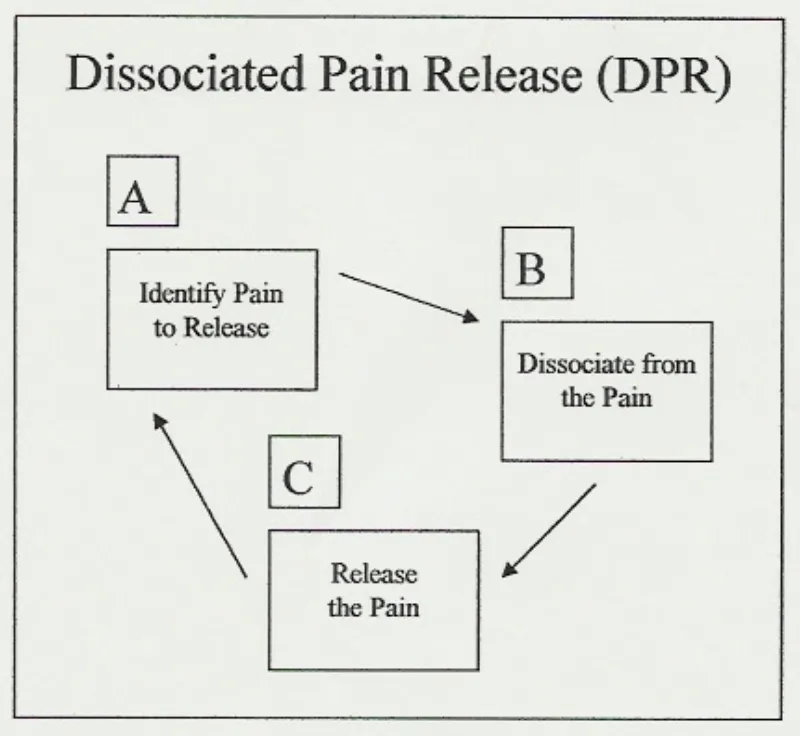
DPR has three cyclical steps: (A) identify pain to release, (B) dissociate from the pain, and (C) release the pain. Once understood, DPR is a simple, repetitive process that applies in many self-help situations. Any user employing DPR expects to complete its A-B-C cycle several times in any one self-help session. It is understood that there may be several painful emotions, different forms of physical pain and other negative bodily sensations that require release, making time and repetition necessary.
IMPORTANT
* DPR is not trauma therapy.
Anne is not a therapist and does not support individuals through trauma therapy. Anne teaches a self-help technique that individuals can apply to many situations in their everyday lives and that they have a right to use to manage any experiences they choose, traumatic or not. It is always recommended that trauma survivors hire a licensed trauma therapists whenever possible. Call 911 in any emergency.
Feeling Suicidal?
Find a Helpline

Anne MacMillan, MLA
Survivor, Consultant, Coach, Educator
Master's Clinical Psychology, Harvard Univerisity
IMPORTANT
* DPR is not trauma therapy.
Anne is not a therapist and does not support individuals through trauma therapy. Anne teaches a self-help technique that individuals can apply to many situations in their everyday lives and that they have a right to use to manage any experiences they choose, traumatic or not.
It is always recommended that trauma survivors hire a licensed trauma therapists whenever possible. Call 911 in any emergency.
Feeling Suicidal?
Find a Helpline:
https://findahelpline.com/
About Me
Like many others, I grew up in a household that didn't offer me the basic protections all children need. I experienced extreme trauma as a very young child and, unfortunately, that trauma continued into my adolescence and adulthood.
I survived adolescence emotionally by focusing on studying contemporary dance, helping me process my emotions and increase my body awareness. As a young adult in my twenties, I was exposed to relaxation and meditation techniques and the idea that healing that comes naturally when we move our eyes as we dream.
In my mid-twenties, memories of traumatic events that had happened during my early childhood began to return to my consciousness. I knew about EMDR (Eye-Movement Desensitization and Reprocessing) therapy for trauma, but wasn't in a situation that allowed me consistent access to a trauma therapist.
So, I began working through my traumatic memories on my own, combining what I'd learned about the emotions I felt in my body through dancing with relaxation and visualization techniques. I added what I decided to call REM Simulation -- or Rapid Eye Movement Simulation. REM sleep is the deep dreaming sleep in which humans naturally process emotions.
The result was a self-help technique that made it possible for me to work through the terrible emotions associated with traumatic events that had occurred in my past and regain the sense of emotional stability I needed -- all without having an opportunity to get the therapeutic support I needed.
Dissociated Pain Release
I dubbed my self-help technique DPR, or Dissociated Pain Release, and decided that I didn't want it to ever become something that anyone with an advanced degree and a lot of privilege could tell people they weren't qualified to perform at home on their own.
Therapy is wonderful and everyone who has access to a therapist should take advantage of that privilege. But recovery strategies should be available to anyone anywhere. That's what DPR is about for me.
From my perspective, DPR is nothing more than a collection of practical ideas put together in one package to help all of us get through the difficult emotions humans feel. It's valuable because it works and it uses human's natural REM (Rapid Eye Movement) sleep processing methods.

My Newest Blog Posts

The Staircase that Rises: Identity in Autistic Development
Series IV, Article 3: The Staircase that Rises: Identity Formation in Autistic Development
People whose development follows the autistic pathway build identity through a different mechanism entirely. The continuous oscillation of the spiral, fed by an uninterrupted stream of body empathy feedback, is not the structure the autistic pathway runs on. What it runs on instead is something more sequential, more deliberate, and more dependent on explicit information: a process of building self-concept from the inside out, through direct access to one's own values, capacities, and ways of engaging with the world (Huang et al., 2017; Milton, 2012).
This difference in mechanism produces a different relationship with the self. Where the outside-in formation of the spiral builds a self-concept continuously calibrated against social reality, updated by every significant encounter, the inside-out approach of the autistic pathway builds something with a different character: a self-concept grounded more directly in the person's own experience of who they are and how they meet the world (Coutelle et al., 2020; Huang et al., 2017). The person who has developed along the autistic pathway often has a clear and stable relationship with their own perspective, a directness of self-knowledge that does not depend on continuous social calibration to exist.
This is a genuine strength, and it should be named as such before anything else is said. The depth of relationship with one's own inner world that the autistic pathway can produce, the clarity about what one values and how one engages and what one knows to be true from the inside, is not a lesser form of self-knowledge. It is a different form, with its own integrity and its own character. The inside-out construction, when it can proceed on solid ground, produces a self that knows itself with a particular kind of directness (Huang et al., 2017).
The question is what solid ground requires.
A Different Rhythm, the Same Engine
The staircase is not without its own oscillation. The same developmental engine that drives the spiral, the back-and-forth of assimilation and accommodation, drives the staircase as well. What differs is the temporal structure through which that oscillation moves (Piaget, 1952).
The vertical rise is the accommodation phase. When the autistic person receives accurate, explicit feedback about who they are, how their actions land on others, or what they genuinely know and value, that information does not arrive as one data point in a continuous stream. It arrives as a concentrated input, and it requires a genuine reorganization of the self-concept to absorb. Something that was not previously understood about the self is now understood. The working self-concept has to make room for it. The staircase rises (Piaget, 1952).
The horizontal surface is the assimilation phase. Having reorganized around the new understanding, the person now needs time to apply it, to test it in the various contexts of daily life, to see whether it holds. This is not stagnation, and it should not be read as one. It is the necessary consolidation of what was just learned: the new self-understanding being integrated into how the person moves through the world, practiced and confirmed until it becomes solid enough to build the next step on (Piaget, 1952).
The oscillation is sequential rather than continuous, separated into distinct phases rather than flowing in the uninterrupted back-and-forth of the spiral. But it is still moving upward. The staircase rises toward the same psychosocial destinations as the spiral, through the same fundamental engine of learning and applying, accommodation and assimilation. What is different is the rhythm, the pace, and the specific conditions the rhythm requires to function (Erikson, 1968; Piaget, 1952).
Baumrind's responsiveness and demandingness apply here as clearly as anywhere in the developmental journey. The holding environment for the staircase needs to be responsive to the horizontal surface, to recognize the consolidation period as legitimate developmental work rather than as stagnation to be accelerated or interrupted. And it needs to be genuinely demanding in the direction of the next vertical rise, offering the calibrated challenge that prompts the next accommodation without pushing so far beyond current ability that the new learning cannot be absorbed (Baumrind, 1971, 1991; Darling & Steinberg, 1993). Csikszentmihalyi's channel appears here too: the vertical rise calibrated to sit just slightly beyond current self-understanding is the one that produces genuine growth (Csikszentmihalyi, 1990). The rise that arrives before the horizontal surface is complete, before the previous learning has been genuinely assimilated, produces overwhelm rather than growth. And the environment that removes all challenge, that treats the horizontal surface as the destination rather than the resting point, leaves the staircase extended on a flat plane that never rises.
What the Staircase Needs
What this means in practice for identity formation is that the autistic pathway depends on something the non-autistic pathway does not require to the same degree: information about the self that is explicit, accurate, and timed to the rhythm of the staircase rather than to the continuous stream of the spiral (Huang et al., 2017; Milton, 2012).
The environments that support autistic identity formation well are environments that can name the self accurately: that can reflect back, in explicit and legible terms, what this particular person's values are, how their actions land on others, what genuine competence they have, and who they actually are rather than who they are being required to perform. That kind of accurate, direct feedback is what fuels the vertical rise. And those same environments need to understand that after the rise comes the surface, and the surface is not failure. It is the assimilation phase, the period of integration, and it requires patient presence rather than pressure to continue climbing before the ground beneath is solid (Baumrind, 1971, 1991; Csikszentmihalyi, 1990; Piaget, 1952).
Most environments have not provided either. And the consequences of that absence, accumulated across the developmental arc the previous series traced, are precisely what make autistic identity formation so difficult.
When the Feedback Returns Distortion
The autistic pathway is not simply receiving less feedback than the non-autistic pathway. It is often receiving feedback that is actively distorted by the double empathy problem, by the implicit neurotype bias research has documented: non-autistic people forming negative first impressions of autistic people within seconds, based on social presentation style rather than the content of what autistic people actually say or do (DeBrabander et al., 2019; Jones et al., 2024; Milton, 2012; Sasson et al., 2017). The autistic person reaching outward, expressing enthusiasm, communicating in their own register, receives back from the non-autistic social world a response frequently shaped by that bias rather than by accurate perception of who they actually are (Sasson et al., 2017).
This has a specific consequence for the inside-out construction of identity. When feedback takes the form of rejection, withdrawal, or social failure, and arrives without the kind of explicit information that would allow the autistic person to understand what produced it, the accommodation phase reorganizes the self-concept around an inaccurate input. The assimilation phase that follows consolidates that distorted understanding into how the person moves through the world. The developmental machinery continues to run, but what it is building is a picture of the self calibrated to distortion rather than to who the person actually is, and a self-concept built on those foundations does not carry the person toward genuine identity formation (Coutelle et al., 2020; Erikson, 1968; McAdams & McLean, 2013; Piaget, 1952).
The self builds an understanding of itself that incorporates the distortion, learning something from the rejection but not what would actually be true or useful. The message received tends to be that the self, as it naturally is, is somehow wrong, rather than that the feedback loop between two differently disposed social actors is producing misattunement for structural reasons that have nothing to do with the autistic person's worth or capacity (Botha & Frost, 2020; Milton, 2012; Sasson et al., 2017). A self that has been consistently receiving back evidence that its natural expressions produce unpredictable negative consequences does not build a confident self-concept from that evidence. It builds something more cautious and more uncertain: a working understanding of itself as a self whose natural way of being is not quite right, whose judgment cannot be fully trusted, whose reach is likely to land wrong in ways that will not be explained (Botha & Frost, 2020; Coutelle et al., 2020; Perry et al., 2022).
When the Construction Materials Go Missing
The most significant disruption to autistic identity formation is not distorted feedback from the outside, serious as that is. It is what masking does to the inside.
The series on boundaries established masking as boundary collapse: the self that stops asserting its own limits and begins organizing itself around the limits the environment has imposed. What masking does to identity specifically is a further extension of that collapse. When the autistic person learns, through accumulated evidence of correction and rejection and social failure, that the authentic self requires adjustment before it will be welcome, the developmental response is to build a performed self that can be offered in the authentic self's place (Pearson & Rose, 2021; Perry et al., 2022). That performed self accumulates, layer by layer, over years of social experience. It learns the scripts, adopts the gestures, calibrates the expressions, and presents to the world something more legible and more neurotype-conforming than the authentic self beneath it (Hull et al., 2020; Lai et al., 2017; Pearson & Rose, 2021; Perry et al., 2022).
The identity cost of this is specific and serious. The inside-out construction depends on having access to the authentic self from which the construction is being made. When a performed self has been built over the authentic one, the vertical rise of the staircase does not have accurate material to work with. The accommodation phase is reorganizing around the performed self rather than the authentic one. The assimilation phase is consolidating a self-concept built from the performance rather than from what is actually there. The staircase is rising, but it is rising on a foundation that does not correspond to the person who is actually living inside it (Coutelle et al., 2020; Pearson & Rose, 2021; Rivera & Paredez, 2023).
The question who am I becomes genuinely difficult not because the self does not exist but because it has become genuinely difficult to locate beneath the accumulated layers of what was required. Research on self-concept clarity in autistic adults consistently finds lower levels of self-concept coherence than in non-autistic comparison groups (Coutelle et al., 2020; Davies et al., 2024). Research on narrative identity, the coherent life story through which identity achieves its felt continuity across time, finds that autistic people's life narratives tend toward less causal and motivational coherence, more difficulty linking experiences into a story of who they are and how they came to be that way (Allé et al., 2025; McAdams, 2001; McAdams & McLean, 2013). These are not failures of intelligence or insight. They are the expected consequences of a developmental process in which the raw material of identity formation has been partially obscured by years of performance, and in which the staircase has been rising on distorted or concealed foundations (Hull et al., 2020; Pearson & Rose, 2021; Perry et al., 2022).
When identity development stalls in this territory, two patterns tend to emerge. In one, the person commits to the performed self as their identity, without having genuinely explored who the authentic self beneath it actually is. The mask becomes the face, presented with a commitment that can look like a settled sense of self but is built on a foundation that has never been truly examined. In the other, the performance has been so total and so sustained that there is no stable self-concept the person can reliably locate. Neither the performed self nor the authentic self feels fully known, and the question who am I generates not a working answer but a disorienting blankness (Coutelle et al., 2020; Marcia, 1966; Pearson & Rose, 2021; Rivera & Paredez, 2023).
Both are developmental outcomes, not character failures. They are what the inside-out construction of identity produces when the conditions that would allow it to proceed on solid ground have not been provided.
What Genuine Autistic Identity Formation Requires
What the inside-out construction needs in order to produce a coherent and stable self is, at its core, conditions that allow the authentic self to be the material the construction is actually built from (Coutelle et al., 2020; Huang et al., 2017; Rivera & Paredez, 2023).
That means environments that can name the authentic self accurately: that can reflect back, in explicit and legible terms, what is genuinely this person rather than what they have been required to perform. It means relationships in which the unmasked self is not merely tolerated but genuinely received, in which authentic expressions are met with accurate response rather than neurotype-biased reaction. And it means clear, direct feedback about how the self's actions land on others, explicit enough to be usable by a nervous system that does not automatically receive the subtle embodied signals through which non-autistic social environments typically communicate these things (Huang et al., 2017; Milton, 2012; Pearson & Rose, 2021; Perry et al., 2022). That is the fuel for the vertical rise. And it means patient environments that understand the horizontal surface that follows: that read the consolidation period as what it actually is, the assimilation of something genuinely new, rather than mistaking it for stagnation or withdrawing support during the phase in which the new self-understanding is being tested and integrated (Baumrind, 1971, 1991; Csikszentmihalyi, 1990; Piaget, 1952).
When those conditions are present, the inside-out construction can proceed with integrity. The staircase rises on solid ground. The self that builds from genuine access to its own values and capacities, in an environment that reflects them accurately, develops the particular kind of self-knowledge the autistic pathway is capable of: deep, direct, and grounded in something real rather than in what was required. That self knows itself with a clarity and a groundedness that is entirely its own (Corden et al., 2021; Huang et al., 2017).
What has been missing is not the capacity. What has been missing is accurate recognition: an environment capable of seeing the authentic self clearly enough to name it. For many autistic people, that recognition arrives through identification, with or without a formal diagnosis, and deepens through community, through the encounter with other autistic people whose ways of being in the world feel, for the first time, genuinely familiar (Botha et al., 2022; Cooper et al., 2023; Corden et al., 2021).
That is where the next post turns.
Next in this series: When the Self Is Finally Named, what happens when identification, with or without formal diagnosis, initiates the identity work that earlier environments did not support, and why autistic community is not simply social connection but a genuine developmental resource.
THE SERIES
Article 1: Identity — The Fifth Task
Article 2: The Oscillation that Rises — Identity Formation in Non-Autistic Development
Article 3: The Staircase that Rises — Identity Formation in Autistic Development
Article 4: When the Self is Finally Named
Article 5: Neurodiverse Relationships — Two Selves, One Room
Article 6: The Self that Knows Where it Stands
References
Allé, M. C., Schneider, P., Rigoulot, L., Gandolphe, M.-C., Danion, J.-M., Coutelle, R., & Berna, F. (2025). Narrative identity differences in autism. Scientific Reports, 15, Article 16990. https://doi.org/10.1038/s41598-025-00178-0
Baumrind, D. (1971). Current patterns of parental authority. Developmental Psychology, 4(1, Pt. 2), 1–103. https://doi.org/10.1037/h0030372
Baumrind, D. (1991). The influence of parenting style on adolescent competence and substance use. The Journal of Early Adolescence, 11(1), 56–95. https://doi.org/10.1177/0272431691111004
Botha, M., Dibb, B., & Frost, D. M. (2022). “It’s being a part of a grand tradition, a grand counter-culture which involves communities”: A qualitative investigation of autistic community connectedness. Autism, 26(8), 2151–2164. https://doi.org/10.1177/13623613221080248
Botha, M., & Frost, D. M. (2020). Extending the minority stress model to understand mental health problems experienced by the autistic population. Society and Mental Health, 10(1), 20–34. https://doi.org/10.1177/2156869318804297
Cooper, K., Russell, A. J., Lei, J., & Smith, L. G. E. (2023). The impact of a positive autism identity and autistic community solidarity on social anxiety and mental health in autistic young people. Autism, 27(3), 848–857. https://doi.org/10.1177/13623613221118351
Corden, K., Brewer, R., & Cage, E. (2021). Personal identity after an autism diagnosis: Relationships with self-esteem, mental wellbeing, and diagnostic timing. Frontiers in Psychology, 12, Article 699335. https://doi.org/10.3389/fpsyg.2021.699335
Coutelle, R., Goltzene, M.-A., Bizet, E., Schoenberger, M., Berna, F., & Danion, J.-M. (2020). Self-concept clarity and autobiographical memory functions in adults with autism spectrum disorder without intellectual deficiency. Journal of Autism and Developmental Disorders, 50, 3874–3882. https://doi.org/10.1007/s10803-020-04447-x
Csikszentmihalyi, M. (1990). Flow: The psychology of optimal experience. Harper & Row.
Darling, N., & Steinberg, L. (1993). Parenting style as context: An integrative model. Psychological Bulletin, 113(3), 487–496. https://doi.org/10.1037/0033-2909.113.3.487
Davies, J., Cooper, K., Killick, E., Sam, E., Healy, M., Thompson, G., Mandy, W., Redmayne, B., & Crane, L. (2024). Autistic identity: A systematic review of quantitative research. Autism Research, 17(5), 874–897. https://doi.org/10.1002/aur.3105
DeBrabander, K. M., Morrison, K. E., Jones, D. R., Faso, D. J., Chmielewski, M., & Sasson, N. J. (2019). Do first impressions of autistic adults differ between autistic and nonautistic observers? Autism in Adulthood, 1(4), 250–257. https://doi.org/10.1089/aut.2019.0018
Erikson, E. H. (1968). Identity: Youth and crisis. W. W. Norton.
Hull, L., Petrides, K. V., & Mandy, W. (2020). The female autism phenotype and camouflaging: A narrative review. Review Journal of Autism and Developmental Disorders, 7, 306–317. https://doi.org/10.1007/s40489-020-00197-9
Huang, A. X., Hughes, T. L., Sutton, L. R., Lawrence, M., Chen, X., Ji, Z., & Zeleke, W. (2017). Understanding the self in individuals with autism spectrum disorder: A review of literature. Frontiers in Psychology, 8, Article 1422. https://doi.org/10.3389/fpsyg.2017.01422
Jones, D. R., Botha, M., Ackerman, R. A., King, K., & Sasson, N. J. (2024). Non-autistic observers both detect and demonstrate the double empathy problem when evaluating interactions between autistic and non-autistic adults. Autism, 28(8), 2053–2065. https://doi.org/10.1177/13623613231219743
Lai, M.-C., Lombardo, M. V., Ruigrok, A. N. V., Chakrabarti, B., Auyeung, B., Szatmari, P., Happé, F., & Baron-Cohen, S. (2017). Quantifying and exploring camouflaging in men and women with autism. Autism, 21(6), 690–702. https://doi.org/10.1177/1362361316671012
Marcia, J. E. (1966). Development and validation of ego-identity status. Journal of Personality and Social Psychology, 3(5), 551–558. https://doi.org/10.1037/h0023281
McAdams, D. P. (2001). The psychology of life stories. Review of General Psychology, 5(2), 100–122. https://doi.org/10.1037/1089-2680.5.2.100
McAdams, D. P., & McLean, K. C. (2013). Narrative identity. Current Directions in Psychological Science, 22(3), 233–238. https://doi.org/10.1177/0963721413475622
Milton, D. E. M. (2012). On the ontological status of autism: The “double empathy problem.” Disability & Society, 27(6), 883–887. https://doi.org/10.1080/09687599.2012.710008
Pearson, A., & Rose, K. (2021). A conceptual analysis of autistic masking: Understanding the narrative of stigma and the illusion of choice. Autism in Adulthood, 3(1), 52–60. https://doi.org/10.1089/aut.2020.0043
Perry, E., Mandy, W., Hull, L., & Cage, E. (2022). Understanding camouflaging as a response to autism-related stigma: A social identity theory approach. Journal of Autism and Developmental Disorders, 52, 800–810. https://doi.org/10.1007/s10803-021-04987-w
Piaget, J. (1952). The origins of intelligence in children (M. Cook, Trans.). International Universities Press. https://doi.org/10.1037/11494-000
Rivera, R. A., & Bennetto, L. (2023). Applications of identity-based theories to understand the impact of stigma and camouflaging on mental health outcomes for autistic people. Frontiers in Psychiatry, 14, Article 1243657. https://doi.org/10.3389/fpsyt.2023.1243657
Sasson, N. J., Faso, D. J., Nugent, J., Lovell, S., Kennedy, D. P., & Grossman, R. B. (2017). Neurotypical peers are less willing to interact with those with autism based on thin slice judgments. Scientific Reports, 7, Article 40700. https://doi.org/10.1038/srep40700

© 2023 REAL Neurodiverse
All Rights Reserved
anne@neurodiversemarriage.com
Text or Call: (617) 996-7239 (United States)