DPR
Dissociated Pain Release
A self-help technique developed by a trauma survivor

Anne MacMillan, MLA
Survivor, Consultant, Coach
Master's Clinical Psychology - Harvard University
Dissociated Pain Release
Self-Help Trauma Support
Dissociated Pain Release
Dissociated Pain Release (DPR) is a self-help technique that allows users to release emotional pain from trauma without re-experiencing it. It is based on the idea that emotional pain is stored in the mind, body, and nervous system and that the stored pain causes distress and discomfort in the present, whether the trauma was a recent event or something that happened many years ago.
There is no need for a DPR user to know where any emotional pain came from. All a user needs to know is that they are currently experiencing unwanted emotional pain and that they would like to release that pain and feel better -- quickly.
Most importantly, in DPR, emotional pains are released while the user is dissociated from them -- allowing the user to process any trauma or distress without being forced to relive the original traumatic experience.
Examples of emotional pain that can be released from the body and nervous system through DPR include rage, anger, shame, sadness, guilt, grief, loneliness, abandonment, anxiety, and fear.
Likewise, DRP allows users to release any stored sensations associated with physical pain or forms of bodily discomfort that happened in the past. DPR users can release sensations of nausea, dizziness, cold, being drugged, etc. Again, all these sensations are released without the DRP user re-experiencing the original potency of any traumatic event. Often DPR users release pain without even knowing what the original traumatic event may have been.
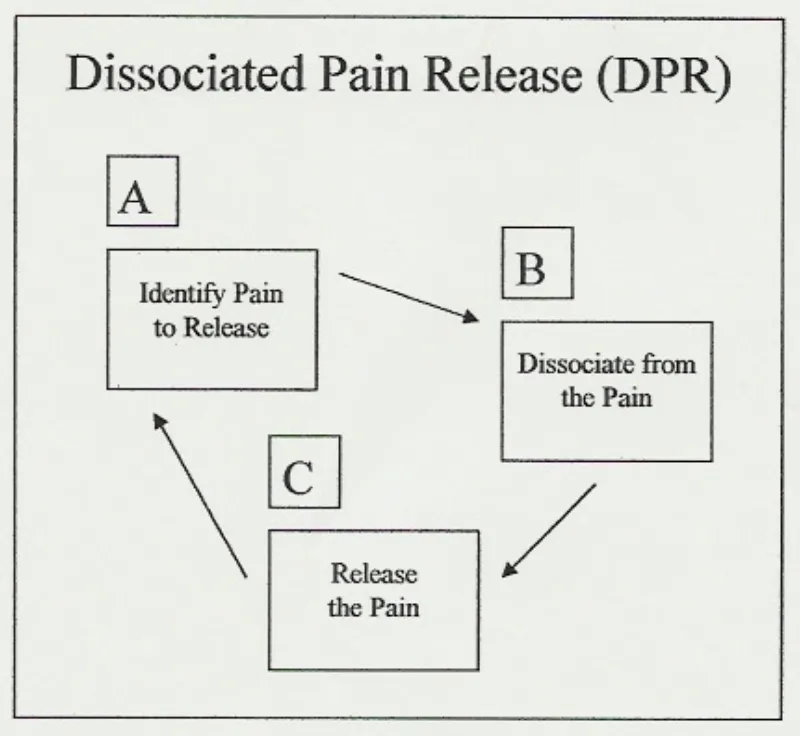
DPR has three cyclical steps: (A) identify pain to release, (B) dissociate from the pain, and (C) release the pain. Once understood, DPR is a simple, repetitive process that applies in many self-help situations. Any user employing DPR expects to complete its A-B-C cycle several times in any one self-help session. It is understood that there may be several painful emotions, different forms of physical pain and other negative bodily sensations that require release, making time and repetition necessary.
IMPORTANT
* DPR is not trauma therapy.
Anne is not a therapist and does not support individuals through trauma therapy. Anne teaches a self-help technique that individuals can apply to many situations in their everyday lives and that they have a right to use to manage any experiences they choose, traumatic or not. It is always recommended that trauma survivors hire a licensed trauma therapists whenever possible. Call 911 in any emergency.
Feeling Suicidal?
Find a Helpline

Anne MacMillan, MLA
Survivor, Consultant, Coach, Educator
Master's Clinical Psychology, Harvard Univerisity
IMPORTANT
* DPR is not trauma therapy.
Anne is not a therapist and does not support individuals through trauma therapy. Anne teaches a self-help technique that individuals can apply to many situations in their everyday lives and that they have a right to use to manage any experiences they choose, traumatic or not.
It is always recommended that trauma survivors hire a licensed trauma therapists whenever possible. Call 911 in any emergency.
Feeling Suicidal?
Find a Helpline:
https://findahelpline.com/
About Me
Like many others, I grew up in a household that didn't offer me the basic protections all children need. I experienced extreme trauma as a very young child and, unfortunately, that trauma continued into my adolescence and adulthood.
I survived adolescence emotionally by focusing on studying contemporary dance, helping me process my emotions and increase my body awareness. As a young adult in my twenties, I was exposed to relaxation and meditation techniques and the idea that healing that comes naturally when we move our eyes as we dream.
In my mid-twenties, memories of traumatic events that had happened during my early childhood began to return to my consciousness. I knew about EMDR (Eye-Movement Desensitization and Reprocessing) therapy for trauma, but wasn't in a situation that allowed me consistent access to a trauma therapist.
So, I began working through my traumatic memories on my own, combining what I'd learned about the emotions I felt in my body through dancing with relaxation and visualization techniques. I added what I decided to call REM Simulation -- or Rapid Eye Movement Simulation. REM sleep is the deep dreaming sleep in which humans naturally process emotions.
The result was a self-help technique that made it possible for me to work through the terrible emotions associated with traumatic events that had occurred in my past and regain the sense of emotional stability I needed -- all without having an opportunity to get the therapeutic support I needed.
Dissociated Pain Release
I dubbed my self-help technique DPR, or Dissociated Pain Release, and decided that I didn't want it to ever become something that anyone with an advanced degree and a lot of privilege could tell people they weren't qualified to perform at home on their own.
Therapy is wonderful and everyone who has access to a therapist should take advantage of that privilege. But recovery strategies should be available to anyone anywhere. That's what DPR is about for me.
From my perspective, DPR is nothing more than a collection of practical ideas put together in one package to help all of us get through the difficult emotions humans feel. It's valuable because it works and it uses human's natural REM (Rapid Eye Movement) sleep processing methods.

My Newest Blog Posts

The Destination
Series VI, Article 5: The Destination
The destination that Erikson's arc describes is not a place and not a moment. It is a quality of relationship with the life that was actually lived: the capacity to look back on it, to hold it clearly, and to recognize it as genuinely and irreversibly one's own (Butler, 1963; Erikson & Erikson, 1997). Not an ideal life. Not the life that would have been lived if the conditions had been different. This particular life, with its specific pathway, its specific developmental history, its specific obstacles and achievements and survivals, held in its entirety and accepted as the life that was actually there.
That is the destination this entire inquiry has been tracing from the beginning. Every article in every series has been working toward this specific point: the demonstration that both developmental pathways, understood accurately and supported genuinely, are capable of arriving at a life that is genuinely, recognizably, and irreversibly one's own. Not identically. Not through the same mechanisms or the same experiences or the same forms of knowing and being known. But at the same destination, by routes that are each genuinely sufficient for getting there.
The Arc, Traced
The journey begins with trust: whether the world is safe enough to rely on, whether the nervous system that arrives into the world will be met with sufficient responsiveness that reaching out becomes the self's characteristic approach rather than withdrawal (Erikson, 1963; Winnicott, 1965). For autistic people, that question is often answered in the context of environments often not calibrated to the specific nervous system doing the trusting (Milton, 2012). For non-autistic people, and particularly for the high body empathetic in MacMillan's theoretical framework, it is answered in the context of what the continuous social oscillation registers and what it learns to expect.
Autonomy, initiative, and industry follow: whether the self is allowed to choose and to act from itself, to reach outward with confidence that initiative will be received as something worth responding to, and to build through productive work a felt sense of genuine competence (Erikson, 1963). Identity asks who the self is, what it values, how it meets the world, and whether it can recognize itself as continuous across time and context (Erikson, 1968; McAdams & McLean, 2013). Intimacy asks who can genuinely know that self and be known by it in return. Generativity asks what the self offers to what comes after it (McAdams & de St. Aubin, 1992). And integrity, the final question, asks whether the life that resulted from all of these developmental encounters can be held, accepted, and recognized as one's own (Erikson & Erikson, 1997).
At each stage, both pathways navigate the same developmental challenge through different mechanisms and in conditions that have historically been calibrated to one of them and not the other. The non-autistic pathway moves through the oscillation of the spiral: the continuous back-and-forth that integrates social feedback into an evolving self-concept and relational capacity (McAdams, 2001; McAdams & McLean, 2013). The autistic pathway moves through the staircase: the concentrated vertical rise of explicit new learning followed by the horizontal surface of genuine consolidation (Baron-Cohen, 2009; Happé & Frith, 2006). Both are moving upward. Both are building, stage by stage, the developmental capacities that the destination requires.
What This Framework Has Named
MacMillan's Spiral and Staircase Model™ is a contribution to a developmental literature that has, since Erikson first described the arc, been treating the non-autistic pathway as the only pathway without naming that assumption (Erikson, 1963; Erikson & Erikson, 1997). What this series has done, across six series and many articles, is make that assumption visible and then replace it with something more accurate and more complete.
What the framework names that was not adequately named before: that autistic and non-autistic development follow genuinely different structural pathways, with different mechanisms, different rhythms, different vulnerabilities, and different conditions for genuine resolution of each stage. That the failure of autistic development to match the non-autistic template is not a failure of development but a failure of the environments that were supposed to support it (Kapp et al., 2013; Milton, 2012). That the conditions each pathway requires are specific and different, and that providing only one set of conditions while expecting both pathways to flourish on them is not a neutral arrangement.
The framework also names, for the first time in a systematic developmental account, what the non-autistic pathway looks like when it meets the autistic pathway in a shared developmental environment: the specific costs to each person's trust, autonomy, identity, intimacy, generativity, and integrity that the structural mismatch between two differently-organized nervous systems produces (Milton, 2012). Those costs have been documented clinically for decades. This framework is an attempt to explain them developmentally, which is both more accurate and more useful than explaining them as deficits located in one person or the other.
And the framework names the possibility of return: that developmental stages missed or inadequately navigated during their expected windows can be reworked later, when the conditions become available, and that the acceptance of autistic identity is often the event that makes those conditions available for the first time (Erikson & Erikson, 1997; Kapp et al., 2013; Leedham et al., 2020). That insight is not in the existing developmental literature. It is MacMillan's specific theoretical contribution, and it matters because it changes what is possible for autistic people at any age: not only understanding what went wrong, but understanding what can still be done about it.
Both Pathways, One Destination
The series has held, from its beginning, a commitment that has not always been easy to sustain across the genuine complexity of what it is describing: that both pathways lead to the same destination, and that both deserve to be taken seriously as routes to that destination rather than one being treated as the default and the other as the variation.
The autistic person who has reworked earlier developmental stages with accurate information, who has found in autistic community and accurate relationships the neurotype-calibrated holding environments those stages required, who has built an identity from the authentic self rather than the performed one, who has learned what genuine intimacy along the staircase pathway requires and found it, who has contributed through the specific channels the staircase builds, and who can now look back on the arc of that journey through a framework accurate enough to make it legible: that person arrives at the destination Erikson described (Erikson & Erikson, 1997; Hull et al., 2017; Kapp, 2020; Kapp et al., 2013; Leedham et al., 2020). Not despite having followed the autistic pathway. Through it.
The non-autistic person who has navigated the oscillation toward genuine trust, who has built a self-concept grounded in something real rather than in the distorted feedback of environments that misread them, who has achieved the assimilative capacity to remain in their own ground even while receiving the experience of others, who has built genuine intimacy through the reciprocal disclosure and genuine reception the spiral runs on, who has offered genuine care outward rather than absorbing it inward: that person also arrives (Erikson & Erikson, 1997; McAdams, 2001; McAdams & de St. Aubin, 1992; McAdams & McLean, 2013). Not despite the particular challenges of their pathway. Through them.
And the person who is still somewhere in the middle of the arc, who is reworking an earlier stage that was not adequately navigated the first time, who is in the moratorium that identification initiates or the horizontal surface of consolidation that follows a significant vertical rise: that person is not behind (Erikson & Erikson, 1997; Leedham et al., 2020). They are on the arc. The developmental journey does not penalize the person who arrives later than expected. It simply continues until the work is done.
The Life Genuinely One's Own
What arrives at the end of the arc, or at whatever point the arc has reached when the life is looked back upon, is not perfection and not the absence of difficulty. It is something more fundamental and more durable than either of those.
It is the self, standing in a clear relationship with the life it has lived. Not at a distance from it, managing it from the outside, or rejecting the parts that were painful or inexplicable. In genuine relationship with it: knowing what the pathway was, understanding what the journey cost, recognizing what was built along the way, and finding in all of it, the trust that was formed and the autonomy that was asserted and the identity that was located and the intimacy that was achieved and the contribution that was made, the coherent shape of a life that was genuinely, recognizably, and irreversibly one's own (Butler, 1963; Erikson & Erikson, 1997; McAdams, 2001).
That is what the MacMillan Spiral and Staircase Model™ has been building toward across this entire body of work. Not the proof that autistic and non-autistic people are the same. Not the erasure of the real and significant differences between the two developmental pathways (Kapp et al., 2013; Milton, 2012). The demonstration that both pathways, followed with genuine understanding and genuine support, lead to the same destination: a self that knows what it is, that has contributed something of what it knew, and that can look back on the arc of a human life and recognize in it, at last and without reservation, itself (Erikson & Erikson, 1997; McAdams & de St. Aubin, 1992).
Both pathways.
Both arrived.
THE SERIES
Article 1: The Arc That Does Not End
Article 2: Returning to Earlier Ground
Article 3: Generativity Across Both Pathways
Article 4: Integrity Across Both Pathways
Article 5: The Destination
References
Baron-Cohen, S. (2009). Autism: The empathizing-systemizing (E-S) theory. Annals of the New York Academy of Sciences, 1156(1), 68–80. https://doi.org/10.1111/j.1749-6632.2009.04467.x
Butler, R. N. (1963). The life review: An interpretation of reminiscence in the aged. Psychiatry, 26(1), 65–76. https://doi.org/10.1080/00332747.1963.11023339
Erikson, E. H. (1963). Childhood and society (2nd ed.). W. W. Norton.
Erikson, E. H. (1968). Identity: Youth and crisis. W. W. Norton.
Erikson, E. H., & Erikson, J. M. (1997). The life cycle completed: Extended version. W. W. Norton.
Happé, F., & Frith, U. (2006). The weak coherence account: Detail-focused cognitive style in autism spectrum disorders. Journal of Autism and Developmental Disorders, 36(1), 5–25. https://doi.org/10.1007/s10803-005-0039-0
Hull, L., Petrides, K. V., Allison, C., Smith, P., Baron-Cohen, S., Lai, M.-C., & Mandy, W. (2017). “Putting on my best normal”: Social camouflaging in adults with autism spectrum conditions. Journal of Autism and Developmental Disorders, 47(8), 2519–2534. https://doi.org/10.1007/s10803-017-3166-5
Kapp, S. K. (Ed.). (2020). Autistic community and the neurodiversity movement: Stories from the frontline. Palgrave Macmillan. https://doi.org/10.1007/978-981-13-8437-0
Kapp, S. K., Gillespie-Lynch, K., Sherman, L. E., & Hutman, T. (2013). Deficit, difference, or both? Autism and neurodiversity. Developmental Psychology, 49(1), 59–71. https://doi.org/10.1037/a0028353
Leedham, A., Thompson, A. R., Smith, R., & Freeth, M. (2020). “I was exhausted trying to figure it out”: The experiences of females receiving an autism diagnosis in middle to late adulthood. Autism, 24(1), 135–146. https://doi.org/10.1177/1362361319853442
McAdams, D. P. (2001). The psychology of life stories. Review of General Psychology, 5(2), 100–122. https://doi.org/10.1037/1089-2680.5.2.100
McAdams, D. P., & de St. Aubin, E. (1992). A theory of generativity and its assessment through self-report, behavioral acts, and narrative themes in autobiography. Journal of Personality and Social Psychology, 62(6), 1003–1015. https://doi.org/10.1037/0022-3514.62.6.1003
McAdams, D. P., & McLean, K. C. (2013). Narrative identity. Current Directions in Psychological Science, 22(3), 233–238. https://doi.org/10.1177/0963721413475622
Milton, D. E. M. (2012). On the ontological status of autism: The “double empathy problem.” Disability & Society, 27(6), 883–887. https://doi.org/10.1080/09687599.2012.710008
Winnicott, D. W. (1965). The maturational processes and the facilitating environment: Studies in the theory of emotional development. International Universities Press.
© 2023 REAL Neurodiverse
All Rights Reserved
anne@neurodiversemarriage.com
Text or Call: (617) 996-7239 (United States)