DPR
Dissociated Pain Release
A self-help technique developed by a trauma survivor

Anne MacMillan, MLA
Survivor, Consultant, Coach
Master's Clinical Psychology - Harvard University
Dissociated Pain Release
Self-Help Trauma Support
Dissociated Pain Release
Dissociated Pain Release (DPR) is a self-help technique that allows users to release emotional pain from trauma without re-experiencing it. It is based on the idea that emotional pain is stored in the mind, body, and nervous system and that the stored pain causes distress and discomfort in the present, whether the trauma was a recent event or something that happened many years ago.
There is no need for a DPR user to know where any emotional pain came from. All a user needs to know is that they are currently experiencing unwanted emotional pain and that they would like to release that pain and feel better -- quickly.
Most importantly, in DPR, emotional pains are released while the user is dissociated from them -- allowing the user to process any trauma or distress without being forced to relive the original traumatic experience.
Examples of emotional pain that can be released from the body and nervous system through DPR include rage, anger, shame, sadness, guilt, grief, loneliness, abandonment, anxiety, and fear.
Likewise, DRP allows users to release any stored sensations associated with physical pain or forms of bodily discomfort that happened in the past. DPR users can release sensations of nausea, dizziness, cold, being drugged, etc. Again, all these sensations are released without the DRP user re-experiencing the original potency of any traumatic event. Often DPR users release pain without even knowing what the original traumatic event may have been.
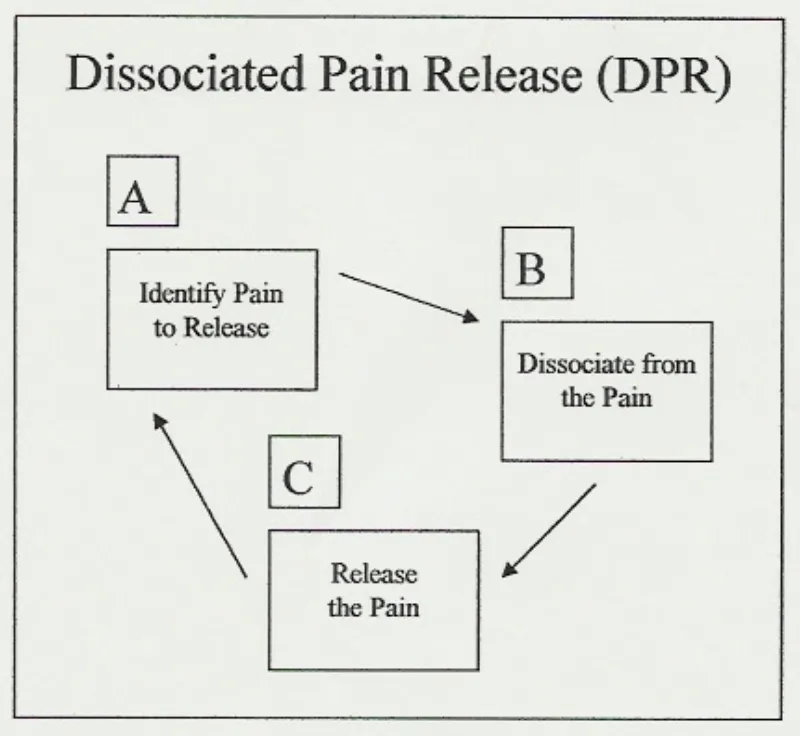
DPR has three cyclical steps: (A) identify pain to release, (B) dissociate from the pain, and (C) release the pain. Once understood, DPR is a simple, repetitive process that applies in many self-help situations. Any user employing DPR expects to complete its A-B-C cycle several times in any one self-help session. It is understood that there may be several painful emotions, different forms of physical pain and other negative bodily sensations that require release, making time and repetition necessary.
IMPORTANT
* DPR is not trauma therapy.
Anne is not a therapist and does not support individuals through trauma therapy. Anne teaches a self-help technique that individuals can apply to many situations in their everyday lives and that they have a right to use to manage any experiences they choose, traumatic or not. It is always recommended that trauma survivors hire a licensed trauma therapists whenever possible. Call 911 in any emergency.
Feeling Suicidal?
Find a Helpline

Anne MacMillan, MLA
Survivor, Consultant, Coach, Educator
Master's Clinical Psychology, Harvard Univerisity
IMPORTANT
* DPR is not trauma therapy.
Anne is not a therapist and does not support individuals through trauma therapy. Anne teaches a self-help technique that individuals can apply to many situations in their everyday lives and that they have a right to use to manage any experiences they choose, traumatic or not.
It is always recommended that trauma survivors hire a licensed trauma therapists whenever possible. Call 911 in any emergency.
Feeling Suicidal?
Find a Helpline:
https://findahelpline.com/
About Me
Like many others, I grew up in a household that didn't offer me the basic protections all children need. I experienced extreme trauma as a very young child and, unfortunately, that trauma continued into my adolescence and adulthood.
I survived adolescence emotionally by focusing on studying contemporary dance, helping me process my emotions and increase my body awareness. As a young adult in my twenties, I was exposed to relaxation and meditation techniques and the idea that healing that comes naturally when we move our eyes as we dream.
In my mid-twenties, memories of traumatic events that had happened during my early childhood began to return to my consciousness. I knew about EMDR (Eye-Movement Desensitization and Reprocessing) therapy for trauma, but wasn't in a situation that allowed me consistent access to a trauma therapist.
So, I began working through my traumatic memories on my own, combining what I'd learned about the emotions I felt in my body through dancing with relaxation and visualization techniques. I added what I decided to call REM Simulation -- or Rapid Eye Movement Simulation. REM sleep is the deep dreaming sleep in which humans naturally process emotions.
The result was a self-help technique that made it possible for me to work through the terrible emotions associated with traumatic events that had occurred in my past and regain the sense of emotional stability I needed -- all without having an opportunity to get the therapeutic support I needed.
Dissociated Pain Release
I dubbed my self-help technique DPR, or Dissociated Pain Release, and decided that I didn't want it to ever become something that anyone with an advanced degree and a lot of privilege could tell people they weren't qualified to perform at home on their own.
Therapy is wonderful and everyone who has access to a therapist should take advantage of that privilege. But recovery strategies should be available to anyone anywhere. That's what DPR is about for me.
From my perspective, DPR is nothing more than a collection of practical ideas put together in one package to help all of us get through the difficult emotions humans feel. It's valuable because it works and it uses human's natural REM (Rapid Eye Movement) sleep processing methods.

My Newest Blog Posts

Neurodiverse Relationships: Two Selves, One Room
Series IV, Article 5: Neurodiverse Relationships: Two Selves, One Room
Every relationship is, in some sense, a developmental environment. Not only for what the two people build together, but for what each person continues to build individually within the shared space. Identity formation does not conclude when a relationship begins. It continues across adulthood, shaped by the relational environments people move through, responsive to the quality of feedback and recognition those environments provide (Erikson, 1968; Kegan, 1982; McAdams, 2001; McAdams & McLean, 2013). Erikson understood this: the identity stage opens onto intimacy, which opens onto generativity, which opens onto integrity. The self is always, at every stage, in some relationship with the environments it inhabits (Erikson, 1968).
In a neurodiverse relationship, both people arrive carrying developmental histories that the previous posts have traced. The autistic person arrives with an inside-out construction that has been shaped by years of navigating environments that rarely provided accurate feedback, that may have been built partly on distorted materials, and that may still be in the moratorium that identification initiates or consolidating a self-concept that is still finding its stability (Erikson, 1968; Marcia, 1966; Milton, 2012). The non-autistic person arrives with an outside-in oscillation that has been shaped by whatever environments they have moved through, and that may have been tilting toward accommodation over assimilation, toward others' perspectives over their own, with the particular intensity that the high body empathetic architecture produces in MacMillan's theoretical framework (Craig, 2009; Critchley et al., 2004; Decety & Jackson, 2004; Lamm et al., 2007).
What happens to both people's identity formation inside the shared space is the subject of this post. Not the full relational dynamic, which the series on boundaries examined in detail, but the specific question of what the neurodiverse relational environment does to each person's ongoing identity development, and what both people would need from the shared space for that development to continue.
What the Non-Autistic Oscillation Needs and What It Encounters
The non-autistic outside-in formation of identity, as Post 2 described, depends on bidirectional social feedback: the self going out, the world responding, the response being integrated, the self going out again with a slightly more calibrated self-concept (Erikson, 1968; McAdams & McLean, 2013; Pfeifer & Berkman, 2018; Yue et al., 2020). What keeps this oscillation running accurately is not only the presence of feedback but its mutuality. The social world needs to be responding to the person genuinely, reflecting back something that corresponds to who they actually are rather than to a projection or a distortion (Ragelienė, 2016; Yue et al., 2020).
In a neurodiverse relationship, the feedback loop that the non-autistic person's oscillation depends on is structurally altered. The autistic partner navigates the social world through the inside-out construction rather than through body empathy, which means they are not automatically returning the kind of continuous, embodied, bidirectional social reflection that the non-autistic developmental pathway runs on (Craig, 2009; Decety & Jackson, 2004; Milton, 2012). The non-autistic person's perspective, their expressions, their emotional states, their sense of how they are being received, is not being reflected back through the same rapid, automatic channel that non-autistic-to-non-autistic interaction provides. The relational field is not empty of response, but it is shaped differently, and the oscillation that the non-autistic person's identity formation depends on is being fed differently than it is built to run (Crompton, Sharp, et al., 2020; Jones et al., 2024; Milton, 2012; Smith et al., 2021).
Over time, the accommodation that the non-autistic person's nervous system moves toward naturally, and that the high body empathetic moves toward with particular ease and force, means that the oscillation begins to skew. The assimilative phase, the forward movement from the self's own perspective, becomes harder to complete. The accommodative phase reorganizes increasingly around the autistic partner's perspective, because that perspective is the most consistent and clearly defined element in the shared space. The non-autistic person's self-concept, which the oscillation was meant to keep calibrated against accurate information about who they are, begins to be calibrated against something else: the shape of the relational field as the autistic partner's perspective organizes it (Decety & Jackson, 2004; Kegan, 1982; Marcia, 1966; McAdams & McLean, 2013).
This is not a character failure on anyone's part. It is the predictable consequence of two developmental pathways meeting in a shared space without adequate understanding of what each one needs (Milton, 2012; Smith et al., 2021; Yew et al., 2023).
What the Autistic Construction Needs and What It Encounters
The autistic inside-out construction of identity, as Post 3 described, depends on receiving accurate feedback about where the self ends and another person begins. Without that feedback, the construction proceeds without calibration, building a self-concept that may extend further than it should without encountering the clear limits that would correct its course (Erikson, 1968; Kegan, 1982; Marcia, 1966; Milton, 2012).
In a neurodiverse relationship, the feedback that the autistic person's construction needs arrives through a specific channel: the other person holding their own ground clearly enough that the encounter with the self's limits is unambiguous. When the autistic person acts in a way that crosses another person's boundary, they need that boundary to be named directly and clearly, because the subtle embodied signals through which non-autistic distress is typically communicated may not arrive in a form the autistic nervous system automatically receives (Jones et al., 2024; Milton, 2012; Smith et al., 2021).
The non-autistic partner, and particularly the high body empathetic non-autistic partner in MacMillan's framework, does something that is almost the opposite of this. Rather than holding ground clearly, the natural movement is toward accommodation: absorbing the crossing, reorganizing around the relational field, finding a way to continue without direct confrontation. The non-autistic partner is not failing. They are doing what their nervous system does. But the consequence for the autistic person's identity construction is significant: the feedback that would allow the inside-out process to proceed accurately, that would tell the self where its limits actually are in relation to others, is not arriving. The construction continues, but without the calibration it depends on (Craig, 2009; Critchley et al., 2004; Decety & Jackson, 2004; Kegan, 1982; Milton, 2012).
Both people are, in the same shared space, inadvertently depriving each other of what their identity formation actually needs. The non-autistic person needs the autistic partner to engage with their perspective directly enough that the oscillation has something real to move against. The autistic person needs the non-autistic partner to hold their own ground clearly enough that the inside-out construction receives accurate information about where the self ends. Neither is providing what the other needs, not from indifference, but because each is doing what their developmental pathway naturally does in the conditions the other creates (Jones et al., 2024; Milton, 2012; Smith et al., 2021; Yew et al., 2023).
The Same Dynamic, Two Different Costs
The identity cost to each person is different in character but parallel in seriousness.
For the non-autistic person, the cost is a gradual loss of oscillatory calibration. The self-concept that was being built through continuous social exchange becomes harder to locate as the primary reference point shifts. The person who arrived in the relationship with some working sense of who they are begins to find that sense harder to hold clearly, more porous, more organized around the relational field of the shared space than around the accurate feedback the oscillation was built to provide. The question who am I becomes harder to answer not because the person has changed fundamentally, but because the developmental process that was keeping the answer current has lost its primary source of calibrating input (Erikson, 1968; Marcia, 1966; McAdams, 2001; McAdams & McLean, 2013).
For the autistic person, the cost is different in shape. The inside-out construction continues, but it continues on uncalibrated ground. The self-concept extends into relational space without encountering the clear feedback that would accurately define its limits. Without that calibration, the patterns of interaction that the construction produces continue and compound without the correction mechanism that would allow the staircase to adjust its course. The autistic person may develop a sense of themselves in the relationship that does not accurately reflect the relational reality, not from arrogance but from the absence of the specific kind of feedback that the inside-out construction runs on (Jones et al., 2024; Milton, 2012; Smith et al., 2021).
What Both People Need
What each person's identity formation needs from the shared space is specific and, importantly, complementary. What one needs is close to what the other needs to provide.
The non-autistic person needs the autistic partner to be present to their non-autistic perspective with enough consistency and directness that the oscillation has something real to move against. Not the continuous, automatic, body-empathy-mediated reflection of non-autistic-to-non-autistic interaction, which the autistic partner cannot provide in that form, but explicit engagement with the non-autistic person's experience: genuine responsiveness to what they communicate, direct acknowledgment of where they stand, the kind of deliberate presence that makes the oscillation's assimilative phase possible (Crompton, Sharp, et al., 2020; Jones et al., 2024; Milton, 2012; Smith et al., 2021). This requires the autistic partner to develop, through the explicit developmental work that Post 3 described, a practiced attention to the non-autistic person's experience that does not come automatically but can be built (Mitran, 2022; Stafford & Dodd, 2023; Yew et al., 2023).
The autistic person needs the non-autistic partner to hold their own ground clearly enough that the inside-out construction receives accurate calibrating feedback. Not confrontationally, but as an act of identity maintenance that is genuinely good for both people. A non-autistic person who knows where they stand and can name it directly provides the autistic partner with the specific kind of feedback the inside-out construction runs on. When the non-autistic person says clearly what they need, what has landed wrong, what they are not willing to accommodate, they are not being difficult. They are providing the developmental resource the autistic partner's identity formation actually requires (Kegan, 1982; Milton, 2012; Smith et al., 2021; Yew et al., 2023).
Neither of these things is simple to do, and neither happens automatically. Both require understanding: a clear picture of what each pathway actually needs, and a willingness to work toward providing it even when the nervous system's natural movement is in a different direction. The non-autistic person whose natural movement is toward accommodation has to work to stay in their own shoes. The autistic person whose natural movement is to extend their perspective into the relational space has to work to receive and integrate the feedback that tells them where the self ends (Erikson, 1968; Kegan, 1982; Marcia, 1966; Milton, 2012).
When both people are doing that work, and when they have adequate support to sustain it, what becomes possible inside the neurodiverse relationship is genuinely developmental for both. The shared space comes closer to what Kegan called a holding environment: a context that simultaneously confirms each person where they are and challenges them toward where they are going (Kegan, 1982; Mitran, 2022; Stafford & Dodd, 2023). Not easily, and not automatically. But with understanding, and with the commitment that genuine care between two people makes possible (Smith et al., 2021; Yew et al., 2023).
That understanding, and what it makes possible for both developmental pathways across the full arc of a life, is where the final post of this series turns.
Next in this series: The Self That Knows Where It Stands, what genuine identity formation looks like for each pathway when the conditions are right, what it makes possible for the stages of development that follow, and why the destination was always the same.
THE SERIES
Article 1: Identity — The Fifth Task
Article 2: The Oscillation that Rises — Identity Formation in Non-Autistic Development
Article 3: The Staircase that Rises — Identity Formation in Autistic Development
Article 4: When the Self is Finally Named
Article 5: Neurodiverse Relationships — Two Selves, One Room
Article 6: The Self that Knows Where it Stands
References
Craig, A. D. (2009). How do you feel—now? The anterior insula and human awareness. Nature Reviews Neuroscience, 10(1), 59–70. https://doi.org/10.1038/nrn2555
Critchley, H. D., Wiens, S., Rotshtein, P., Öhman, A., & Dolan, R. J. (2004). Neural systems supporting interoceptive awareness. Nature Neuroscience, 7(2), 189–195. https://doi.org/10.1038/nn1176
Crompton, C. J., Sharp, M., Axbey, H., Fletcher-Watson, S., Flynn, E. G., & Ropar, D. (2020). Neurotype-matching, but not being autistic, influences self and observer ratings of interpersonal rapport. Frontiers in Psychology, 11, Article 586171. https://doi.org/10.3389/fpsyg.2020.586171
Decety, J., & Jackson, P. L. (2004). The functional architecture of human empathy. Behavioral and Cognitive Neuroscience Reviews, 3(2), 71–100. https://doi.org/10.1177/1534582304267187
Erikson, E. H. (1968). Identity: Youth and crisis. W. W. Norton.
Gates, J. A., Kang, E., & Lerner, M. D. (2023). Social knowledge and performance in autism: A critical review. Current Psychiatry Reports, 25(12), 817–827. https://doi.org/10.1007/s11920-023-01461-7
Jones, D. R., Botha, M., Ackerman, R. A., King, K., & Sasson, N. J. (2024). Non-autistic observers both detect and demonstrate the double empathy problem when evaluating interactions between autistic and non-autistic adults. Autism, 28(8), 2053–2065. https://doi.org/10.1177/13623613231219743
Kegan, R. (1982). The evolving self: Problem and process in human development. Harvard University Press.
Lamm, C., Batson, C. D., & Decety, J. (2007). The neural substrate of human empathy: Effects of perspective-taking and cognitive appraisal. Journal of Cognitive Neuroscience, 19(1), 42–58. https://doi.org/10.1162/jocn.2007.19.1.42
Marcia, J. E. (1966). Development and validation of ego-identity status. Journal of Personality and Social Psychology, 3(5), 551–558. https://doi.org/10.1037/h0023281
McAdams, D. P. (2001). The psychology of life stories. Review of General Psychology, 5(2), 100–122. https://doi.org/10.1037/1089-2680.5.2.100
McAdams, D. P., & McLean, K. C. (2013). Narrative identity. Current Directions in Psychological Science, 22(3), 233–238. https://doi.org/10.1177/0963721413475622
Milton, D. E. M. (2012). On the ontological status of autism: The “double empathy problem.” Disability & Society, 27(6), 883–887. https://doi.org/10.1080/09687599.2012.710008
Mitran, C. L. (2022). A new framework for examining impact of neurodiversity in couples in intimate relationships. The Family Journal, 30(3), 437–443. https://doi.org/10.1177/10664807211063194
Pfeifer, J. H., & Berkman, E. T. (2018). The development of self and identity in adolescence: Neural evidence and implications for a value-based choice perspective on motivated behavior. Child Development Perspectives, 12(3), 158–164. https://doi.org/10.1111/cdep.12279
Ragelienė, T. (2016). Links of adolescents identity development and relationship with peers: A systematic literature review. Journal of the Canadian Academy of Child and Adolescent Psychiatry, 25(2), 97–105.
Ryan, R. M., & Deci, E. L. (2017). Self-determination theory: Basic psychological needs in motivation, development, and wellness. Guilford Press.
Smith, R., Netto, J., Gribble, N. C., & Falkmer, M. (2021). “At the end of the day, it’s love”: An exploration of relationships in neurodiverse couples. Journal of Autism and Developmental Disorders, 51, 3311–3321. https://doi.org/10.1007/s10803-020-04790-z
Stafford, A. (2023). Relationship-counselling recommendations for partnerships involving autistic adults: A scoping review. Psychotherapy and Counselling Journal of Australia, 11(1). https://doi.org/10.59158/001c.77496
Yew, R. Y., Hooley, M., & Stokes, M. A. (2023). Factors of relationship satisfaction for autistic and non-autistic partners in long-term relationships. Autism, 27(8), 2348–2360. https://doi.org/10.1177/13623613231160244
Yue, C., Yang, Y., He, W., Yue, T., & Pan, W. (2020). The memory effect of reflected self-appraisals on different types of others. Frontiers in Psychology, 11, Article 553585. https://doi.org/10.3389/fpsyg.2020.553585
© 2023 REAL Neurodiverse
All Rights Reserved
anne@neurodiversemarriage.com
Text or Call: (617) 996-7239 (United States)