DPR
Dissociated Pain Release
A self-help technique developed by a trauma survivor

Anne MacMillan, MLA
Survivor, Consultant, Coach
Master's Clinical Psychology - Harvard University
Dissociated Pain Release
Self-Help Trauma Support
Dissociated Pain Release
Dissociated Pain Release (DPR) is a self-help technique that allows users to release emotional pain from trauma without re-experiencing it. It is based on the idea that emotional pain is stored in the mind, body, and nervous system and that the stored pain causes distress and discomfort in the present, whether the trauma was a recent event or something that happened many years ago.
There is no need for a DPR user to know where any emotional pain came from. All a user needs to know is that they are currently experiencing unwanted emotional pain and that they would like to release that pain and feel better -- quickly.
Most importantly, in DPR, emotional pains are released while the user is dissociated from them -- allowing the user to process any trauma or distress without being forced to relive the original traumatic experience.
Examples of emotional pain that can be released from the body and nervous system through DPR include rage, anger, shame, sadness, guilt, grief, loneliness, abandonment, anxiety, and fear.
Likewise, DRP allows users to release any stored sensations associated with physical pain or forms of bodily discomfort that happened in the past. DPR users can release sensations of nausea, dizziness, cold, being drugged, etc. Again, all these sensations are released without the DRP user re-experiencing the original potency of any traumatic event. Often DPR users release pain without even knowing what the original traumatic event may have been.
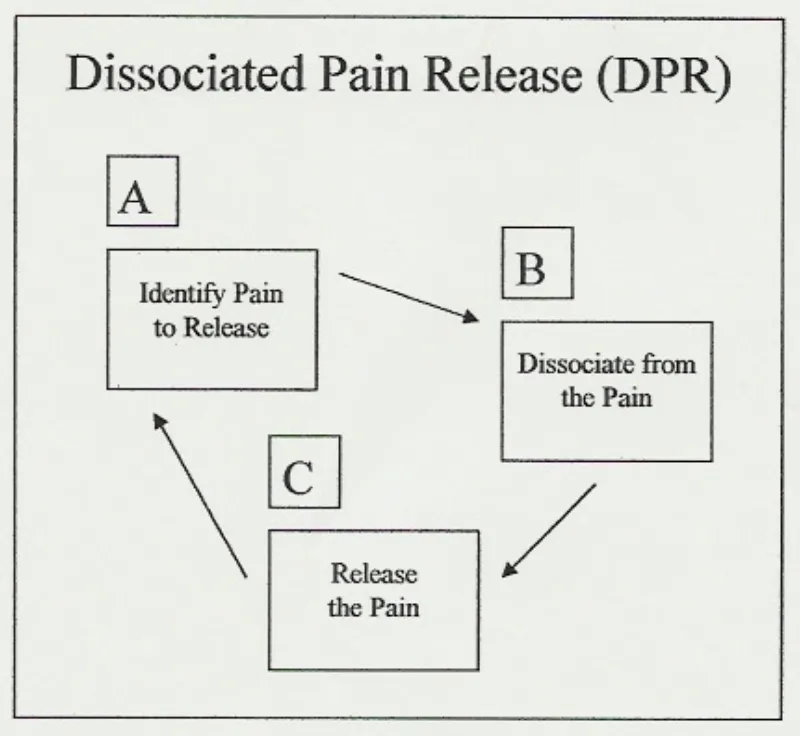
DPR has three cyclical steps: (A) identify pain to release, (B) dissociate from the pain, and (C) release the pain. Once understood, DPR is a simple, repetitive process that applies in many self-help situations. Any user employing DPR expects to complete its A-B-C cycle several times in any one self-help session. It is understood that there may be several painful emotions, different forms of physical pain and other negative bodily sensations that require release, making time and repetition necessary.
IMPORTANT
* DPR is not trauma therapy.
Anne is not a therapist and does not support individuals through trauma therapy. Anne teaches a self-help technique that individuals can apply to many situations in their everyday lives and that they have a right to use to manage any experiences they choose, traumatic or not. It is always recommended that trauma survivors hire a licensed trauma therapists whenever possible. Call 911 in any emergency.
Feeling Suicidal?
Find a Helpline

Anne MacMillan, MLA
Survivor, Consultant, Coach, Educator
Master's Clinical Psychology, Harvard Univerisity
IMPORTANT
* DPR is not trauma therapy.
Anne is not a therapist and does not support individuals through trauma therapy. Anne teaches a self-help technique that individuals can apply to many situations in their everyday lives and that they have a right to use to manage any experiences they choose, traumatic or not.
It is always recommended that trauma survivors hire a licensed trauma therapists whenever possible. Call 911 in any emergency.
Feeling Suicidal?
Find a Helpline:
https://findahelpline.com/
About Me
Like many others, I grew up in a household that didn't offer me the basic protections all children need. I experienced extreme trauma as a very young child and, unfortunately, that trauma continued into my adolescence and adulthood.
I survived adolescence emotionally by focusing on studying contemporary dance, helping me process my emotions and increase my body awareness. As a young adult in my twenties, I was exposed to relaxation and meditation techniques and the idea that healing that comes naturally when we move our eyes as we dream.
In my mid-twenties, memories of traumatic events that had happened during my early childhood began to return to my consciousness. I knew about EMDR (Eye-Movement Desensitization and Reprocessing) therapy for trauma, but wasn't in a situation that allowed me consistent access to a trauma therapist.
So, I began working through my traumatic memories on my own, combining what I'd learned about the emotions I felt in my body through dancing with relaxation and visualization techniques. I added what I decided to call REM Simulation -- or Rapid Eye Movement Simulation. REM sleep is the deep dreaming sleep in which humans naturally process emotions.
The result was a self-help technique that made it possible for me to work through the terrible emotions associated with traumatic events that had occurred in my past and regain the sense of emotional stability I needed -- all without having an opportunity to get the therapeutic support I needed.
Dissociated Pain Release
I dubbed my self-help technique DPR, or Dissociated Pain Release, and decided that I didn't want it to ever become something that anyone with an advanced degree and a lot of privilege could tell people they weren't qualified to perform at home on their own.
Therapy is wonderful and everyone who has access to a therapist should take advantage of that privilege. But recovery strategies should be available to anyone anywhere. That's what DPR is about for me.
From my perspective, DPR is nothing more than a collection of practical ideas put together in one package to help all of us get through the difficult emotions humans feel. It's valuable because it works and it uses human's natural REM (Rapid Eye Movement) sleep processing methods.

My Newest Blog Posts
Neurodiverse Relationship Dynamics™: A Three-Domain Framework
Neurodiverse Relationship Dynamics™: A Three-Domain Framework
Neurodiverse Relationship Dynamics™ (NRD™) describe the patterns that emerge when people with different neurologies—most often autistic and non-autistic—attempt to build and sustain relationships together. These dynamics are not caused by lack of effort, care, or commitment. They arise from fundamental differences in how different brains perceive, interpret, and navigate the social world.
NRD™ begins with perception. Autistic and non-autistic individuals take in social information differently, prioritize different cues, and rely on different internal processes to make sense of interactions. These differences shape how people understand one another’s intentions, how they experience closeness and distance, and how they respond to uncertainty or stress in relationships. Long before conflict appears, these neurological differences are already influencing how safety, trust, and meaning are constructed.
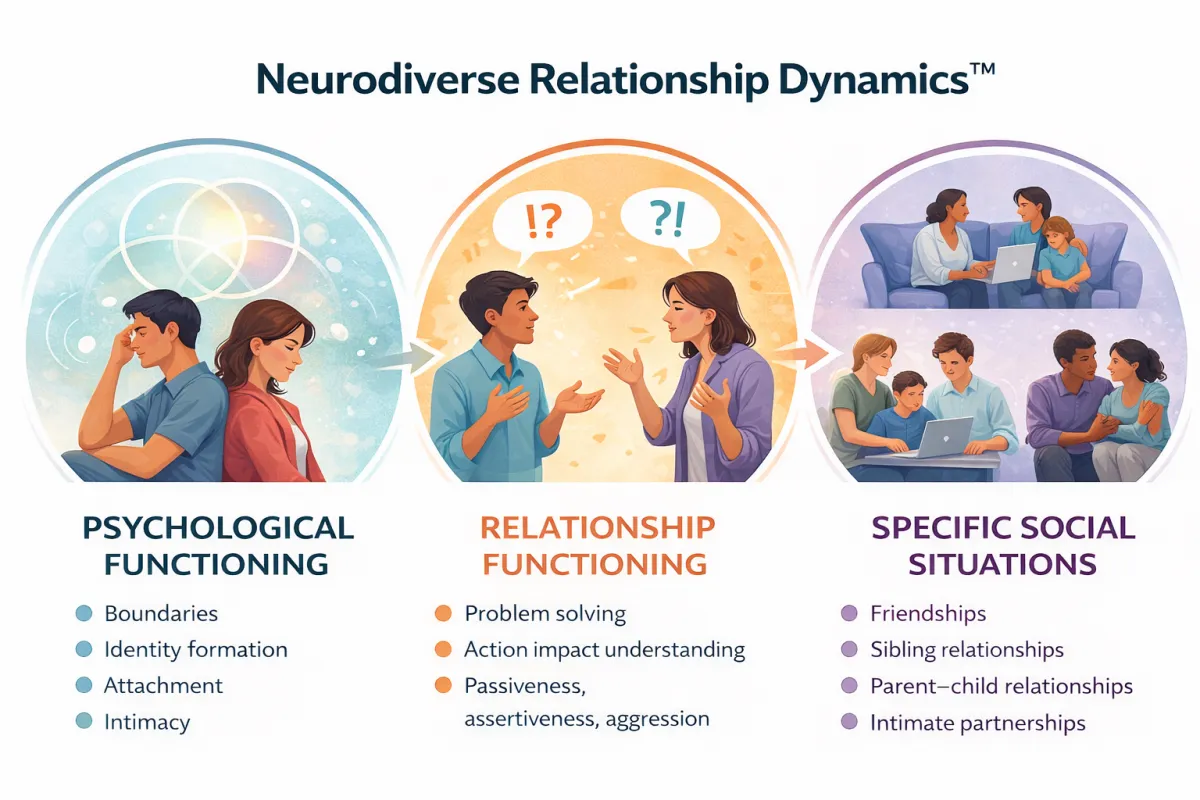
To fully understand NRD™, it is helpful to think in terms of three interconnected domains. Each domain represents a different layer of functioning that contributes to relational experience over time.
Learn More About R.E.A.L. Neurodiverse™
Psychological Functioning
The first domain concerns how individuals experience themselves within relationships. In neurodiverse systems, psychological functioning is often shaped by ongoing misattunement—subtle differences in perception that accumulate across years of interaction. This domain includes:
Attachment — how safety and trust are formed and maintained
Boundaries — how limits are sensed, communicated, and respected
Identity formation — how people come to define who they are in relation to others
Intimacy — how closeness is experienced, desired, or avoided
These processes develop internally, but they are deeply influenced by relational context. Over time, people may adapt by suppressing needs, blurring boundaries, or distancing from parts of themselves in order to preserve connection. When psychological functioning is not recognized as part of NRD™, these adaptations are often mistaken for personality traits rather than survival strategies.
Relationship Functioning
The second domain focuses on how people coordinate with one another once they are in relationship. This is where NRD™ often becomes most visible, especially when strain increases. Relationship functioning includes:
Problem solving — how differences are addressed and resolved
Action impact understanding — how clearly and to what extent each person perceives the effects of their actions on others
Passiveness, assertiveness, and aggression — how needs and boundaries are expressed under pressure
These patterns do not exist in isolation. They are shaped by psychological functioning and by the degree of safety present in the relationship. What may appear as avoidance, rigidity, or escalation is often an adaptive response to chronic misalignment rather than a deliberate relational stance.
Specific Social Situations
The third domain recognizes that neurodiverse dynamics change depending on context. The same neurological differences can produce very different experiences depending on the type of relationship involved. NRD™ plays out differently in:
Friendships, where expectations are flexible but repair is limited
Sibling relationships, where early roles and long histories persist
Parent–child relationships, where authority and dependency shape interaction
Intimate life partnerships, where attachment, intimacy, and daily coordination converge
As relational intensity and dependency increase, so does the complexity of NRD™. A pattern that feels manageable in a friendship may become exhausting or destabilizing in parenting or intimate partnership.
Holding the Whole System
These three domains—psychological functioning, relationship functioning, and specific social situations—are always interacting. NRD™ is not about fixing one behavior or improving one skill. It is about understanding how neurological differences shape entire relational systems over time.
When NRD™ is understood in this way, people are less likely to blame themselves or one another for patterns that were never individually chosen. Instead, they gain a clearer view of the invisible forces shaping their relationships—and the insight needed to make informed, self-respecting choices about how to move forward.
Learn More About R.E.A.L. Neurodiverse™
© 2023 REAL Neurodiverse
All Rights Reserved
anne@neurodiversemarriage.com
Text or Call: (617) 996-7239 (United States)